1. Wprowadzenie
This manual provides instructions for the installation, operation, and maintenance of the Nice Domi W1 bidirectional wall-mounted radio transmitter. The Nice Domi W1 replaces the previous ERA W1 model, offering updated functionalities and compatibility for controlling various home automation systems.
It is designed for controlling roller shutters, blinds, awnings, and other motorized installations compatible with Nice technology.
2. Koniec produktuview
The Nice Domi W1 is an intelligent wall-mounted radio transmitter featuring bidirectional communication for feedback, intuitive controls, and a modern design. It allows for individual, grouped, or centralized control of compatible devices.


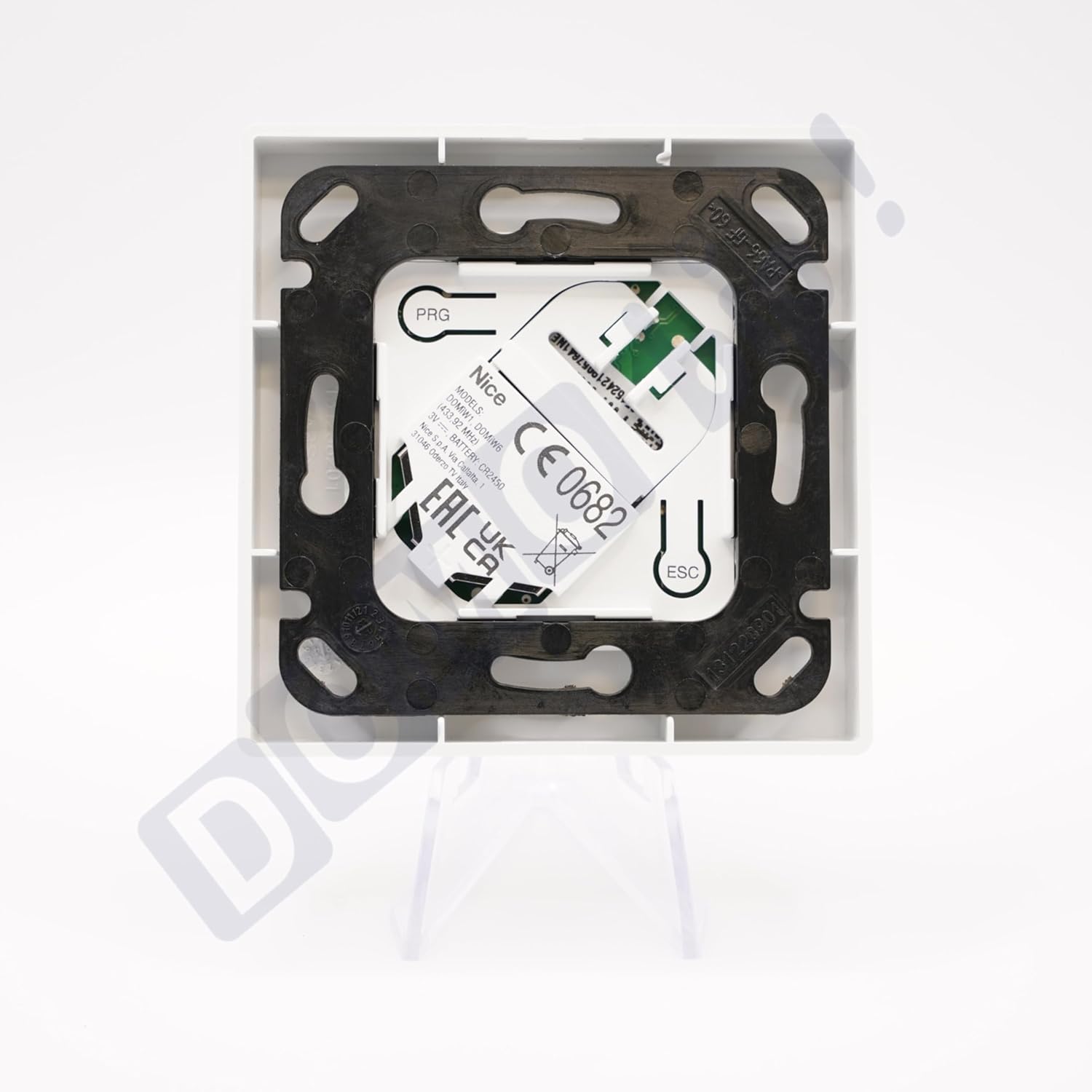
Główne cechy:
- Komunikacja dwukierunkowa: Provides visual and audible confirmation of commands and indicates the status of automated devices (open, closed, or partially open).
- Intuicyjna kontrola: Large buttons for easy operation.
- Wielofunkcyjna dioda LED: For signaling and programming status.
- Łatwa instalacja: Quick mounting with the included wall support.
- Nowoczesny design: Elegant and compact, designed to integrate seamlessly into various environments.
- Efektywność energetyczna: Optimized power consumption for environmental consideration.
3. Specyfikacje techniczne
| Specyfikacja | Wartość |
|---|---|
| Numer modelu | DomiW1 |
| Producent | Ładny |
| Typ nadajnika | Bidirectional (unidirectional mode also possible) |
| Częstotliwość radiowa | 433.92MHz |
| Radio Coding | BD Technology (bidirectional) for feedback, O-Code compatible (unidirectional) |
| Zakres | Approximately 100 meters in open field |
| Zasilacz | 3V Lithium Battery (CR2450) |
| Autonomia baterii | Estimated 3 years with 10 transmissions per day |
| Temperatura pracy | -5 °C do +55 °C |
| Stopień ochrony | IP40 (tylko do użytku w pomieszczeniach) |
| Wymiary (dł. x szer. x wys.) | Wymiary: 50 x 50 x 13 mm |
| Waga | 24 gramów |
| Kolor | Biały |
| Zawarte komponenty | Bateria w zestawie |
4. Konfiguracja
4.1. Montaż nadajnika
- Choose a suitable indoor location for installation, away from direct moisture or extreme temperatures.
- Use the included wall support to fix the transmitter to the wall. Ensure the mounting surface is clean and flat.
- Secure the mounting plate using appropriate screws (not included, typically).
- Snap the Domi W1 transmitter onto the mounted plate.
4.2. Initial Programming (Pairing with Receiver)
The Domi W1 needs to be paired with a compatible Nice receiver (e.g., OXI, OXIBD, FLOX2R, FLOXI2R) to control your automated devices. Refer to the receiver's specific instruction manual for detailed pairing procedures. General steps often include:
- Put the receiver into programming mode (usually by pressing a button on the receiver).
- On the Domi W1, press and hold the 'PRG' button (located on the rear, visible when removed from the mounting plate) until the LED on the transmitter indicates programming mode.
- Transmit a command (e.g., press the 'Up' button) from the Domi W1.
- The receiver should confirm successful pairing (e.g., by flashing its LED or moving the connected device).
- Exit programming mode on both the receiver and transmitter.
The Domi W1 can also be programmed via another already memorized transmitter. Consult the advanced programming section of the full Nice manual for details.
5. Instrukcja obsługi
The Nice Domi W1 features three main control buttons and an 'i' information button:
- Przycisk w górę (▲): Activates the upward movement of the connected device (e.g., opening a roller shutter).
- Przycisk Stop (–): Stops the movement of the connected device.
- Przycisk w dół (▼): Activates the downward movement of the connected device (e.g., closing a roller shutter).
- 'i' Information Button: Used for checking the status of the device and for certain programming functions. When pressed, the LED will indicate the status of the last command or the device's current position (if bidirectional communication is active).
5.1. Bidirectional Feedback
When paired with a bidirectional receiver (e.g., OXIBD), the Domi W1 provides feedback:
- Command Confirmation: Visual and/or audible signals confirm that a command has been received by the automated device.
- Wskazanie stanu: The 'i' button and LED can indicate the current status of the automated device (e.g., fully open, fully closed, or partially open).
5.2. Command Modes
- Kontrola indywidualna: Control a single automated device.
- Grouped Control: Control multiple devices simultaneously that are programmed into the same group.
- Centralne sterowanie: Control all programmed devices from a single transmitter.
6. Zgodność
The Nice Domi W1 is compatible with a range of Nice automation systems:
6.1. Compatible Receivers
- OXI and OXIBD (bidirectional receivers)
- FLOX2R, FLOXI2R (unidirectional receivers)
6.2. Compatible Motors and Automation Systems
- Nice motors for roller shutters and blinds (e.g., Era Fit, Era Inn series).
- Gate and garage door systems equipped with compatible Nice receivers.
6.3. Yubii Ecosystem Integration
The Domi W1 can be integrated into the Nice Yubii ecosystem for centralized management and automated scenarios, allowing for advanced control and smart home functionalities.
7. Konserwacja
7.1. Wymiana baterii
The Domi W1 is powered by a 3V lithium battery (CR2450). When the battery is low, the LED indicator may signal this condition. To replace the battery:
- Carefully detach the transmitter from its wall mounting plate.
- Znajdź komorę baterii z tyłu urządzenia.
- Wyjmij starą baterię CR2450.
- Włóż nową baterię CR2450, zwracając uwagę na prawidłową polaryzację.
- Reattach the transmitter to its mounting plate.
The estimated battery life is 3 years with typical usage (10 transmissions per day).
7.2. Czyszczenie
As the device has an IP40 protection rating, it is intended for indoor use only. Clean the surface of the transmitter with a soft, dry cloth. Do not use abrasive cleaners or liquids, as these may damage the device.
8. Rozwiązywanie Problemów
If you experience issues with your Nice Domi W1, consider the following:
- No Response from Device:
- Check if the battery needs replacement (refer to Section 7.1).
- Ensure the transmitter is within range of the receiver (approx. 100m in open field, less indoors).
- Verify that the transmitter is correctly paired with the receiver (refer to Section 4.2).
- Check for any obstructions or sources of radio interference between the transmitter and receiver.
- Krótki zasięg:
- Wymień baterię.
- Ensure there are no large metal objects or thick walls obstructing the signal path.
- Incorrect Device Status Indication:
- Ensure the receiver is bidirectional (e.g., OXIBD) and properly configured for feedback.
- Re-pair the transmitter with the receiver.
For persistent issues not resolved by these steps, please contact Nice customer support or a qualified technician.
9. Gwarancja i wsparcie
The Nice Domi W1 is designed for robust daily use, ensuring stable performance even in environments with potential interference. For specific warranty terms and conditions, please refer to the documentation provided at the time of purchase or visit the official Nice webstrona.
For technical assistance, spare parts availability, or further inquiries, please contact Nice customer support through their official channels.


