1. Wprowadzenie
Thank you for choosing the DIGOO PPT1 Remote Dog Training Collar. This manual provides detailed instructions for the safe and effective use of your training system. Please read this manual thoroughly before operating the device to ensure proper function and to maximize training effectiveness for your dog. This system is designed to assist in training dogs and correcting undesirable behaviors through beep, vibration, and static stimulation modes.
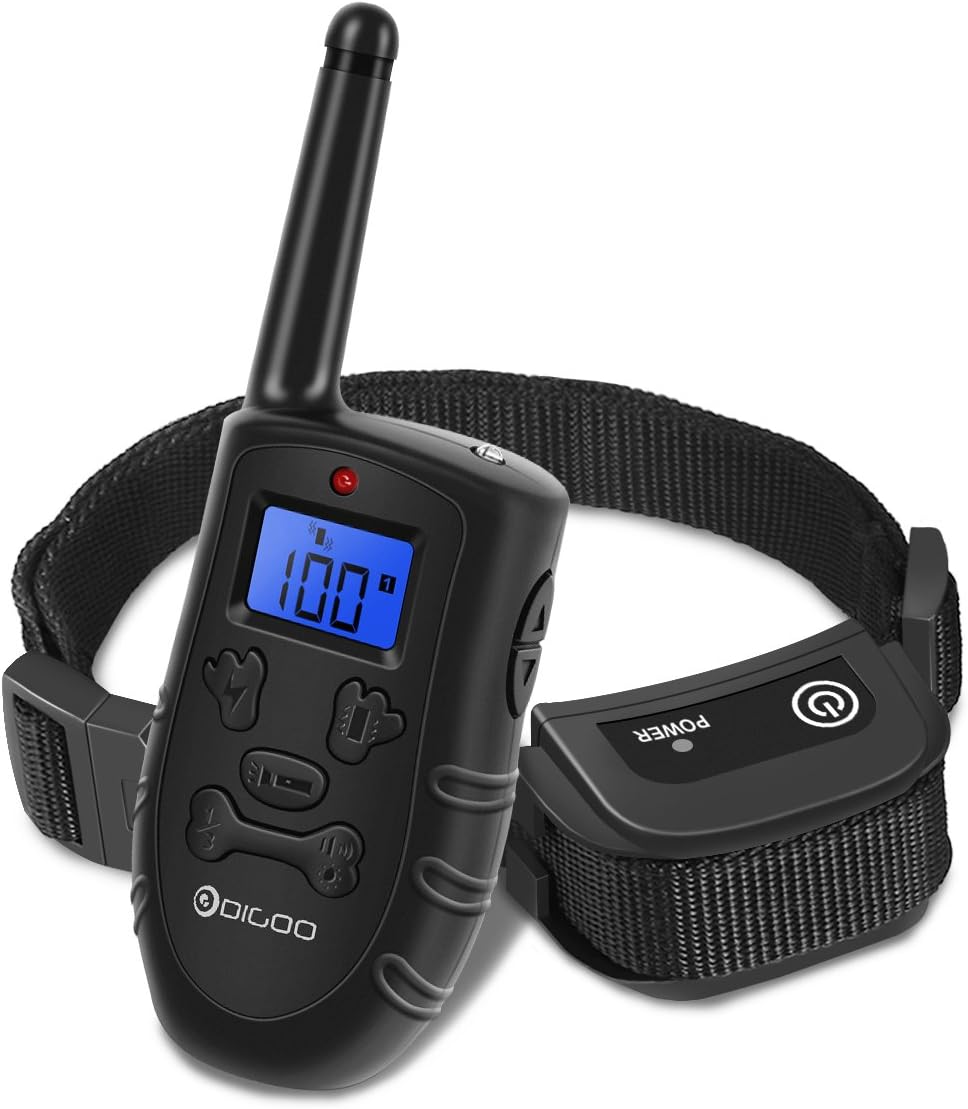
Image: The DIGOO PPT1 remote dog training collar system, showing the handheld remote transmitter and the receiver collar.
2. Zawartość opakowania
Sprawdź, czy w przesyłce znajdują się wszystkie elementy wymienione poniżej:
- 1 x DIGOO DG-PPT1 Remote Transmitter
- 1 x DIGOO DG-PPT1 Waterproof Receiver Collar
- 4 x DIGOO DG-PPT1 Contact Screws (two sizes)
- 1 x DIGOO DG-PPT1 USB Charge Cable (Y-splitter)
- 1 x DIGOO DG-PPT1 Test Light
- 1 x Instrukcja obsługi (ten dokument)
3. Koniec produktuview
3.1 Nadajnik zdalny

Image: Detailed diagram of the remote transmitter, highlighting its components such as the LCD screen, antenna, LED light, indicator, up/down buttons for vibration/shock, vibration button, shock button, LED light button, channel switch button, light/sound button, and charging port.
- Antena: Do transmisji sygnału.
- Światło LED: Indicates operation and battery status.
- Wskaźnik: Shows current mode and level.
- Ekran LCD: Blue backlit display for day and night visibility, showing channel, mode, level, and battery status.
- Przyciski w górę/w dół: Adjust vibration and static stimulation levels (0-100).
- Przycisk wibracji: Activates vibration mode.
- Przycisk wstrząsu: Activates static stimulation mode.
- Przycisk światła LED: Activates the receiver's LED light.
- Channel Switch Button (1-2-3): Selects the receiver collar to control (up to 3 collars).
- Light/Sound Button: Activates beep sound mode.
- Otwór do ładowania: Port ładowania USB.
3.2 Kołnierz odbiornika
- Punkty kontaktowe: Dostarcza stymulację statyczną.
- Przycisk zasilania: Włącza/wyłącza odbiornik.
- Port ładowania: Port ładowania USB.
- Kontrolka: Shows power and operational status.
- Regulowany pasek: Fits neck sizes from 11.8 inches (30cm) to 23.6 inches (60cm).
- Wodoodporna konstrukcja: Allows use in wet conditions, including swimming.
4. Konfiguracja
4.1 Ładowanie urządzeń
Both the remote transmitter and receiver collar use rechargeable lithium-ion batteries. Use the provided Y-splitter USB charging cable to charge both devices simultaneously.
- Connect the Y-splitter USB cable to a standard USB power adapter (not included) or a computer USB port.
- Plug one micro-USB end into the charging port of the remote transmitter.
- Plug the other micro-USB end into the charging port of the receiver collar.
- Charge for approximately 3-4 hours until fully charged. The indicator lights will change to indicate full charge (refer to device indicators for specific behavior).
Note: A full charge typically provides up to 2 weeks of use, depending on frequency.
4.2 Włączanie/wyłączanie
- Zdalny nadajnik: Press any button to activate. It will automatically enter standby mode after 5 minutes of inactivity to save power.
- Obroża odbiornika:
- Włączyć: Press and hold the power button on the receiver until the working indicator light illuminates.
- Wyłączyć: When the working indicator is not shining, press and hold the power button for a few seconds until the working indicator flashes twice, then release.
4.3 Parowanie pilota i odbiornika
The remote and receiver are typically pre-paired from the factory. If re-pairing is needed or if you are adding additional collars:
- Upewnij się, że oba urządzenia są całkowicie naładowane i wyłączone.
- Turn on the remote transmitter. Select the desired channel (1, 2, or 3) using the channel switch button.
- Naciśnij i przytrzymaj przycisk zasilania na obroży odbiornika, aż kontrolka zacznie szybko migać.
- Within 10 seconds, press the "Shock" or "Vibration" button on the remote transmitter.
- If pairing is successful, the receiver's indicator light will stop flashing and remain solid for a moment, then flash slowly.
- To pair additional collars, repeat the process, selecting a different channel on the remote for each new collar.

Image: Illustration demonstrating how one remote transmitter can be paired with and control up to three separate receiver collars, each on its own channel.
4.4 Montaż kołnierza
Prawidłowe dopasowanie obroży odbiornika jest kluczowe dla skutecznego i bezpiecznego działania. Punkty styku muszą mieć bezpośredni kontakt ze skórą psa.

Image: Visual guide for adjusting the collar strap and selecting the appropriate contact screw length (6mm or 14mm) to ensure proper fit for dogs of various sizes, from 10 to 150 lbs.
- Upewnij się, że obroża jest zdjęta.
- Select the appropriate length of contact screws (6mm or 14mm) based on your dog's coat length. Longer screws are for thicker coats.
- Attach the chosen contact screws securely to the receiver.
- Place the receiver collar around your dog's neck, ensuring the contact points are positioned underneath the neck.
- Dopasuj pasek tak, aby przylegał, ale nie za ciasno. Powinieneś móc wygodnie wsunąć dwa palce między pasek a szyję psa.
- The collar should not be worn for more than 12 hours a day to prevent skin irritation. Regularly check your dog's neck for any signs of irritation.
5. Instrukcja obsługi
The DIGOO PPT1 offers three training modes: Beep, Vibration, and Static Stimulation.
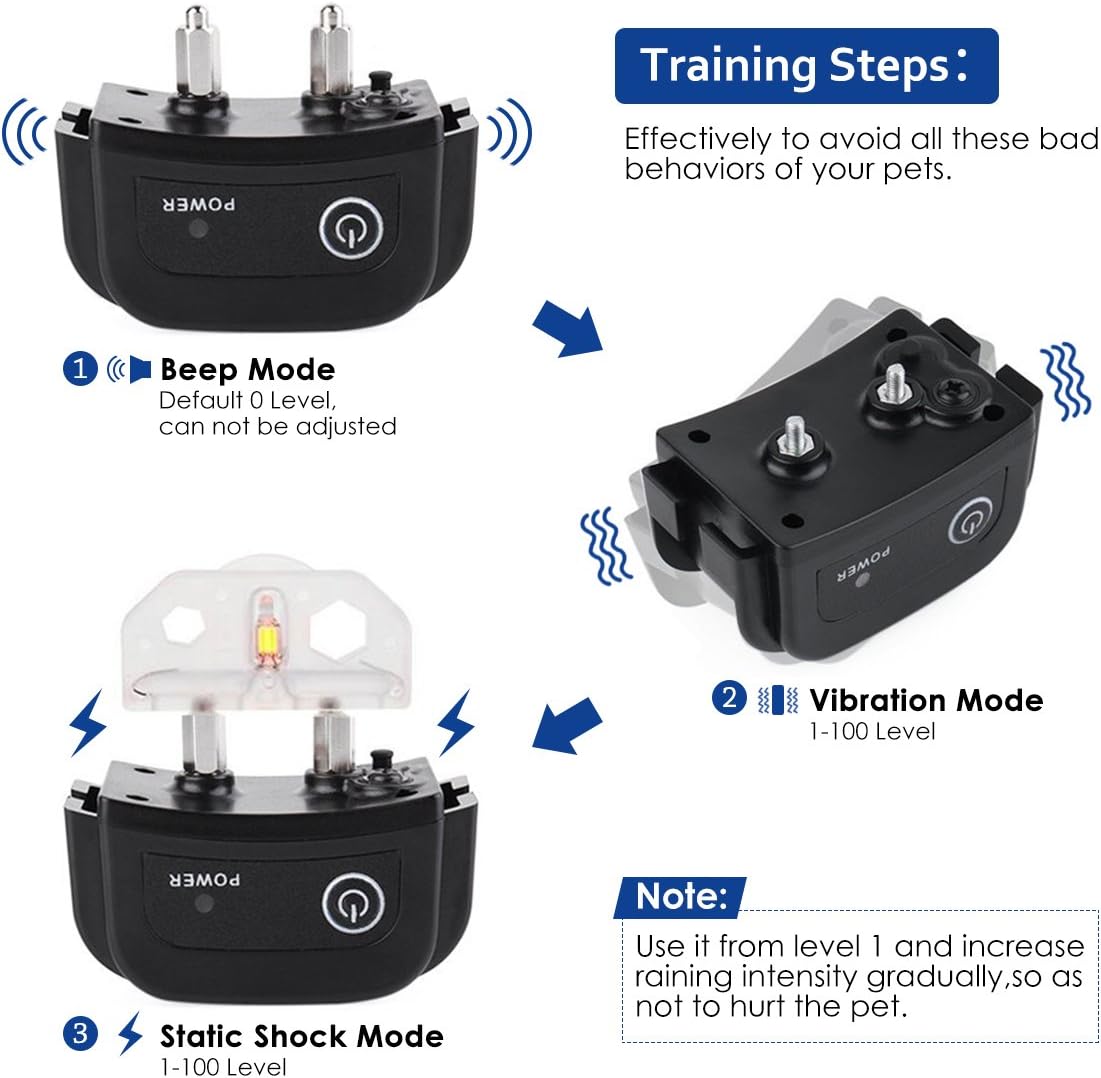
Image: Visual representation of the three training modes: Beep (default level 0, not adjustable), Vibration (levels 1-100), and Static Shock (levels 1-100). A note advises to start with level 1 and gradually increase intensity.
5.1 Beep Mode
- Naciśnij Light/Sound Button na pilocie.
- The receiver will emit an audible beep sound.
- This mode is ideal for giving warnings or attracting your dog's attention. The beep level is fixed and not adjustable.
5.2 Tryb wibracji
- Naciśnij Przycisk wibracji na pilocie.
- Użyj Przyciski góra/dół to select a vibration level from 0 to 100.
- The receiver will vibrate according to the selected intensity.
- Start with the lowest effective level and gradually increase if necessary.
5.3 Static Stimulation Mode
- Naciśnij Przycisk wstrząsu na pilocie.
- Użyj Przyciski góra/dół to select a static stimulation level from 0 to 100.
- The receiver will deliver a static pulse according to the selected intensity.
- Always start with the lowest effective level (level 1) and increase gradually. Use the included test light to verify static function.
- This mode should be used cautiously and only when necessary for correcting serious undesirable behaviors.
5.4 Zasięg pilota zdalnego sterowania
The remote control has an effective range of up to 330 yards (approximately 300 meters) in open areas. Environmental factors and obstacles can affect this range.

Image: Visual representation of the remote control's effective range, showing a dog being trained in an open field up to 330 yards away, and a smaller range of 165 yards in areas with barriers.
6. Wskazówki szkoleniowe
- Kluczem jest konsekwencja: Stosuj obroże konsekwentnie, gdy chcesz skorygować konkretne zachowania.
- Wzmocnienie pozytywne: Always pair corrections with positive reinforcement when your dog performs the desired action.
- Zacznij od niskiego poziomu: Begin with the lowest effective stimulation level and only increase if your dog does not respond.
- Krótkie sesje: Aby utrzymać zaangażowanie psa, sesje szkoleniowe powinny być krótkie i pozytywne.
- Nadzór: Never leave the collar on an unsupervised dog for extended periods.
- Not for Punishment: This device is a training aid, not a punishment tool. Use it responsibly and humanely.
7. Konserwacja
7.1 Czyszczenie
- Wyczyść pilota i odbiornik za pomocąamp płótno. Nie używaj ostrych chemikaliów.
- Regularly clean the contact points on the receiver to ensure proper function and prevent skin irritation.
7.2 Wodoodporność
The receiver collar is designed to be waterproof, allowing your dog to swim or be in rainy conditions while wearing it. The remote transmitter is not waterproof and should be kept dry.

Image: A golden retriever splashing in water, wearing the DIGOO PPT1 waterproof receiver collar. A close-up inset shows the special rubber cover on the receiver, ensuring its waterproof capability even during swimming.
7.3 Pielęgnacja baterii
- Przed pierwszym użyciem należy całkowicie naładować urządzenie.
- Naładuj baterię, gdy wskaźnik poziomu naładowania baterii wskazuje niski poziom naładowania.
- If storing for extended periods, charge the devices every few months to maintain battery health.
8. Specyfikacje
| Funkcja | Specyfikacja |
|---|---|
| Wyświetlacz | Blue Backlit LCD |
| Tryby pracy | Sygnał dźwiękowy, wibracje, stymulacja statyczna |
| Poziomy wibracji | 0-100 poziomów |
| Poziomy stymulacji statycznej | 0-100 poziomów |
| Minimum Collar Size | 11.8 cali (30 cm) |
| Maximum Collar Size | 23.6 cali (60 cm) |
| Czas ładowania | 3-4 godzin |
| Czas pracy | Up to 2 weeks (with typical use) |
| Źródło zasilania | Kabel USB do ładowania |
| Zasięg pilota | Up to 330 yards (open area) |
| Stopień wodoodporności odbiornika | Waterproof (suitable for swimming) |
| Odpowiednia waga psa | 10 funtów - 150 funtów |
| Wymiary produktu | Wymiary 19 x 14 x 5.99 cm |
| Waga produktu | 260 gramów |
| Numer modelu | DIGOOWolifui147 |
9. Rozwiązywanie Problemów
| Problem | Możliwa przyczyna | Rozwiązanie |
|---|---|---|
| Collar not working / No response | Low battery; Not turned on; Not paired; Out of range. | Charge both devices; Turn on both devices; Re-pair the remote and receiver; Move closer to the receiver. |
| Static stimulation not felt | Collar not fitted properly; Contact points too short; Low battery; Level too low. | Adjust collar fit; Use longer contact screws; Charge receiver; Increase stimulation level (gradually). Use test light to verify function. |
| Remote LCD screen is dim or blank | Low battery; Auto-standby mode. | Charge the remote; Press any button to wake it up. |
| Shortened remote range | Environmental interference; Obstacles; Low battery. | Move to an open area; Charge both devices. |
10. Gwarancja i wsparcie
DIGOO offers a 1-year worry-free return/refund policy for the dog training collar. For any problems or questions, please contact customer support at support@mydigoo.com. Responses are typically provided within 24 hours.
For further details, please visit the manufacturer's official webstrona.


