Produkt ponadview
The Hager MCN140 Miniature Circuit Breaker (MCB) is a single-pole, 40A device designed for electrical circuit protection. It features a 6kA short-circuit breaking capacity and a C-curve tripping characteristic, making it suitable for general purpose applications where moderate inrush currents are expected.
Główne cechy:
- Number of poles: 1 P
- Prąd znamionowy: 40 A
- Product long description: MCB 1P 6kA C-40A 1M Curve C
- Rated short circuit breaking capacity Icn AC according IEC60898-1: 6 kA
- Kraj pochodzenia: Francja
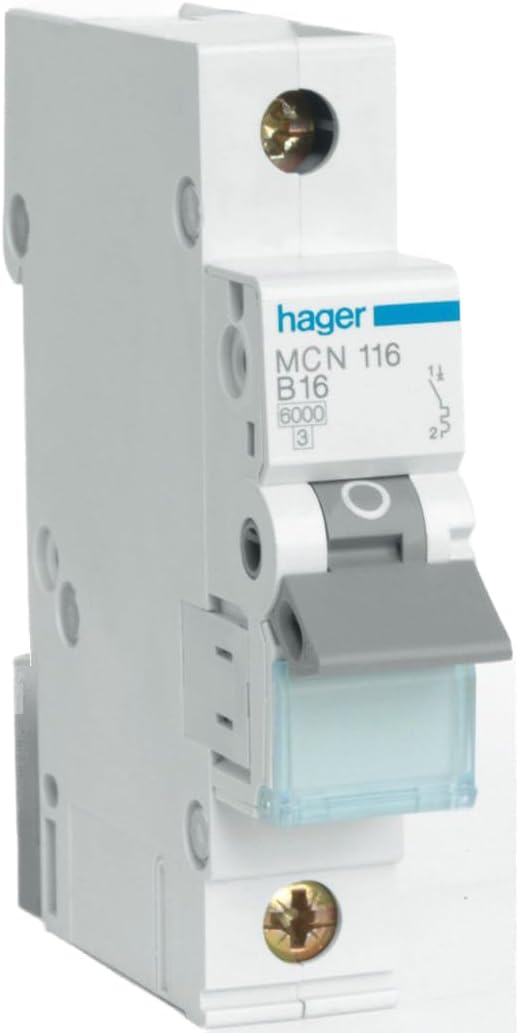
Obraz: Przód view of the Hager MCN140 Miniature Circuit Breaker, showing the toggle switch and product labeling.

Obraz: Bok view of the Hager MCN140 Miniature Circuit Breaker, illustrating its compact design for DIN rail mounting.
Informacje dotyczące bezpieczeństwa
WARNING: Electrical shock hazard. Installation and maintenance of this device must be performed by a qualified electrician in accordance with all local and national electrical codes. Always disconnect power at the main service panel before working with electrical circuits.
- Ensure power is OFF and verified before installation or inspection.
- Nie omijaj ani tamper with the circuit breaker's internal mechanisms.
- Verify correct wiring and connections to prevent damage, fire, or injury.
- Use appropriate personal protective equipment (PPE), including insulated tools and gloves.
Instrukcja instalacji
Wymagane narzędzia:
- Screwdriver (appropriate size for terminal screws)
- Szczypce boczne
- Tomtage tester / Multimeter
Kroki instalacji:
- Odłączenie zasilania: Turn off the main power supply to the electrical panel where the MCB will be installed. Verify power is off using a voltage tester on all relevant circuits.
- Montowanie: The Hager MCN140 MCB is designed for DIN rail mounting. Align the MCB with the DIN rail and press firmly until it clicks securely into place.
- Okablowanie: Connect the incoming phase (live) wire to the top terminal and the outgoing load wire to the bottom terminal. Ensure wires are stripped to the correct length (typically 10-12mm) and securely fastened in the terminals. The terminal screws should be tightened to the specified torque (refer to product label if available, otherwise standard electrical practices apply, typically 2.0-2.5 Nm).
- Weryfikacja: Double-check all connections for tightness, correct polarity, and proper insulation. Ensure no bare wires are exposed.
- Zamknięcie panelu: Close the electrical panel cover securely, ensuring all safety barriers are in place.
- Przywrócenie zasilania: Przywróć zasilanie głównego panelu serwisowego.
Działanie
The Hager MCN140 MCB operates as a protective device for electrical circuits. It has two primary states: ON and OFF, and a tripped state.
Włączanie/wyłączanie:
- To turn the circuit ON, push the toggle switch upwards to the 'I' (ON) position.
- To turn the circuit OFF, push the toggle switch downwards to the 'O' (OFF) position.
Tripping Mechanism:
The MCB automatically trips to the 'O' (OFF) position in the event of an overload or short circuit. This protects the circuit from damage and prevents electrical hazards.
- Zabezpieczenie przed przeciążeniem: If the current flowing through the circuit exceeds the rated current of 40A for a sustained period, the thermal mechanism within the MCB will heat up and trip the breaker.
- Zabezpieczenie przed zwarciem: In the event of a sudden, high current surge (short circuit), the electromagnetic mechanism will trip the MCB almost instantaneously, providing rapid protection.
Konserwacja
Miniature Circuit Breakers like the Hager MCN140 are generally maintenance-free devices due to their sealed construction. However, periodic visual inspection is recommended to ensure continued safe operation.
- Roczna inspekcja: Visually inspect the MCB and its connections annually for any signs of overheating (discoloration, melting), loose connections, or physical damage (cracks, breaks).
- Czyszczenie: If necessary, gently clean the exterior of the MCB with a dry, lint-free cloth. Do not use liquids, solvents, or abrasive cleaners, as these can damage the device or pose an electrical hazard.
- Testowanie: Do not routinely test the tripping mechanism by intentionally creating faults. If the MCB frequently trips, investigate the cause of the overload or short circuit rather than repeatedly resetting the breaker. Frequent tripping without a clear cause may indicate a faulty MCB or a persistent electrical issue.
Rozwiązywanie problemów
| Problem | Możliwa przyczyna | Rozwiązanie |
|---|---|---|
| MCB trips frequently | Overloaded circuit, short circuit, faulty appliance, or damaged wiring. | Disconnect all appliances from the circuit. Reset the MCB. If it trips again immediately, there may be a short circuit or wiring issue. Consult a qualified electrician. |
| MCB does not reset | Persistent fault (overload/short circuit) or internal damage to the MCB. | Ensure all loads are disconnected from the circuit. If it still doesn't reset, the MCB may be faulty and require replacement by a qualified electrician. |
| MCB feels hot to the touch | Luźne połączenia, ciągłe przeciążenie lub wewnętrzna usterka. | Immediately disconnect power to the entire panel. Do not touch the hot MCB. This indicates a serious issue that could lead to fire. Contact a qualified electrician for immediate inspection and repair. |
Dane techniczne
| Atrybut | Wartość |
|---|---|
| Numer modelu | MCN140 |
| Liczba słupów | 1 strony |
| Prąd znamionowy | 40 A |
| Rated Short Circuit Breaking Capacity (Icn) | 6 kA (according to IEC60898-1) |
| Krzywa wyzwalania | C-Curve |
| Tomtage | 400 wolty |
| Typ montażu | Montaż na szynie DIN |
| Waga przedmiotu | 100 gramów |
| Wymiary produktu | Wymiary 1.75 x 7 x 8.3 cm |
| Producent | Hager |
| Kraj pochodzenia | Francja |
Gwarancja i wsparcie
For warranty information and technical support regarding your Hager MCN140 Miniature Circuit Breaker, please refer to the official Hager website or contact your authorized distributor. Keep your purchase receipt as proof of purchase for any warranty claims.
For general inquiries, complex troubleshooting, or professional installation/repair, it is highly recommended to consult a qualified and certified electrician.


