
1. Wprowadzenie
The PQWT PQ125B is an advanced underground water leak detector specifically engineered for identifying leaks in pressurized pipelines within outdoor environments. This device utilizes a factory-developed UI interaction system with a touchscreen display, offering clear functional modules and operational guidance. It is designed for precise localization of water leaks using high-precision acoustic sensors, making it an invaluable tool for both experienced professionals and new users.

Image: The PQWT PQ125B Water Leak Detector, featuring its main unit with a touchscreen display and an acoustic sensor, shown in an outdoor setting near a fire hydrant, illustrating its application for detecting leaks in pressurized pipelines.
2. Zawartość opakowania
Upon unboxing your PQWT PQ125B Water Leak Detector, please verify that all the following components are included:
- Host Unit (Main Device)
- Słuchawki
- Rumak
- Kabel danych USB
- Pasek
- Uchwyt kontrolny
- Listening Rod
- RC-S3 Acoustic Chamber Resonance Sensor
- Etui transportowe

Obraz: kompleksowy view of all components included in the PQWT PQ125B package, neatly arranged on a surface, including the host machine, headphones, various sensors, cables, and accessories.
Wideo z rozpakowywania
Video: This video demonstrates the unboxing process of the PQ125 Series Pipe Water Leak Detector, showing each component as it is removed from the carrying case.
3. Funkcje produktu
- Prosta obsługa: The PQ125B features a user-friendly UI interaction system with a touchscreen that clearly displays each functional module. It provides operational guidance and error pop-ups, making leak detection accessible even for inexperienced users.
- Dokładna lokalizacja: Equipped with two leak detection modes (General Detection Mode and Location Mode), the device allows users to quickly scan large areas and then pinpoint exact leak points by comparing signal strengths from sixteen collected data points.
- Czujniki o wysokiej precyzji: The PQ125B utilizes the RC-S3 Acoustic Chamber Resonance Sensor and Listening Rod, specifically designed for outdoor and industrial leak detection. This sensor monitors changes in sound wave reflection and superposition patterns, offering high sensitivity to minor vibrations.
- Professional Noise-Canceling Headphones: Advanced anti-interference circuit design eliminates noise from digital circuits, ensuring clear sound for accurate detection.

Image: A close-up of the top-level acoustic sensor, highlighting its built-in preamplifier circuit for superior noise-capturing capability.

Image: A user wearing professional noise-canceling headphones while operating the PQWT PQ125B, emphasizing the advanced anti-interference circuit design for clear audio.
Film wprowadzający do produktu
Video: This video provides a general introduction to the PQ125B product, showcasing its main features and components.
4. Konfiguracja
Follow these steps to set up your PQWT PQ125B Water Leak Detector:
- Zamocuj pasek na ramię: Connect the shoulder strap to the main host unit for comfortable carrying during operation.
- Podłącz czujnik: Open the black cap of the sensor's aviation connector. Align the groove on the M16 aviation plug with the notch on the sensor's aviation connector and insert it. Rotate and tighten the nut securely.
- Connect Control Handle: Align the groove on the GX12 aviation plug at the other end of the control handle with the notch on the main unit's aviation port. Insert it and tighten securely.
- Podłącz słuchawki: Insert the headphone jack into the designated port on the main unit. Adjust the headphones for comfort.
- Włączanie: Press and hold the power switch on the main unit for 3-5 seconds to turn on the device. The system will boot up and enter the main interface.

Image: A visual guide illustrating the assembly steps for the PQWT water leak detector, including connecting the shoulder strap, sensors, and headphones to the main unit.
5. Instrukcja obsługi
The PQWT PQ125B offers various detection modes. Ensure you select the appropriate mode for your environment.
5.1 Outdoor Detection Mode
This mode is ideal for detecting leaks in municipal water supply pipelines, fire-fighting pipelines, and underground pressure pipelines.
- Pre-Detection: Before starting, thoroughly understand the pipeline's position and routing in the area to be inspected.
- Rozmieszczenie czujnika: Place the acoustic sensor on the ground directly above the suspected pipeline.
- Dostosuj ustawienia: Using the control handle, set the volume to 5 and the gain to 3 for optimal listening.
- General Detection: Press the control handle switch to start leak monitoring. Stay at each point for approximately 8-10 seconds. Move the sensor along the pipeline in 1-meter increments. Compare the sound signal from the previous point to the next. If the sound differs or becomes louder, and the time-domain dynamic waveform is continuous with stable amplitude, this location may be a suspected leak.
- Location Mode (Verification): Once a suspected leak area is identified, use this point as the center. Compare signal strength in all directions to confirm the suspected leak location. Then, enter Positioning Mode for further verification. The screen displays 16 signal collection boxes for up to 16 points, allowing easy comparison of signal strengths to determine the leak location.

Image: The PQWT PQ125B Water Leak Detector being used outdoors, with the sensor placed on the ground above a pipeline, demonstrating the general detection process.
Outdoor Detection Operation Video
Video: This video provides a detailed demonstration of the PQ125 Series Water Leak Detector in operation, including assembly and outdoor leak detection procedures.
5.2 Indoor Detection Mode
For indoor hot/cold water pipes or underfloor heating pipes, use the appropriate dual-membrane resonance sensor.
- Pre-Detection Notice: Before using the Leak Detector for indoor pipes, perform a pressure retention test. If pressure drops, it indicates a leak. Confirm the pipeline's position and routing using an Indoor Pipe Route Locator or plumbing/electrical layout drawings.
- Wybór czujnika: Use the Dual-Membrane Resonance Sensor DMR-H40 for narrow-space detection (e.g., gaps between objects or walls) or DMR-V59 for indoor floor detection.
- Rozmieszczenie czujnika: Place the selected sensor on the ground or wall above the suspected pipeline.
- Dostosuj ustawienia: Using the control handle, set the volume to 5 and the gain to 3.
- General Detection: Press the control handle switch to start leak monitoring. Stay at each point for 8-10 seconds. Move the sensor along the pipeline in 0.5-meter increments. Remember the sound from the previous point for comparison. If the sound differs or becomes louder, and the waveform is continuous with stable amplitude, it may indicate a leak.
- Positioning Mode (Verification): Use the suspected leak point as the center and compare signal strength in all directions to confirm the leak location. Then enter Positioning Mode for further verification, following the same process as outdoor detection.
Indoor Sensor Principle Video
Video: This video explains the principle of the PQ125 Indoor Dual Membrane Resonance Sensors, demonstrating how they detect leaks in indoor environments.
5.3 Gas Detection Mode
For gas leak detection, a hydrogen-nitrogen gas mixture is injected into the pipeline (95% nitrogen, 5% hydrogen).
- Inject Gas: Inject the hydrogen-nitrogen gas mixture into the pipeline.
- Konfiguracja czujnika: Take out the Tracer Leak Detection Sensor (TLS-H8). Align the groove of the GX12 aviation plug on the sensor with the notch on the main unit's aviation port and insert, tightening securely. Insert the metal head of the telescopic rod into the Tracer Leak Detection Sensor port and tighten.
- Rozgrzewka: Tap to enter Gas Detection mode. Wait for the sensor to warm up for 3 minutes. After preheating, tap "Confirm" and reset the sensor data.
- Wykrywanie: Adjust the telescopic rod to a suitable length. Move the Tracer Leak Detection Sensor close to the ground in a sweeping motion. When the sensor detects leakage gas, the signal bar and value will change. The closer to the leak, the higher the value; farther away, the value decreases.
- Notatka: Gas can only penetrate to the surface through permeable materials, so the highest reading point is not always the exact leak location. Gas detection is only for determining the general leak area. For higher accuracy, combine with Outdoor Detection mode.

Image: The PQWT PQ125E model demonstrating gas tracer detection, showing the device's interface with a gas concentration graph and a user operating the telescopic rod with the gas sensor.
Outdoor Acoustic Chamber Resonance Sensor Principle Video
Video: This video illustrates the principle of the PQ125 Outdoor Acoustic Chamber Resonance Sensor, detailing how it functions to detect leaks in outdoor environments.
6. Konserwacja
To ensure the longevity and optimal performance of your PQWT PQ125B, follow these maintenance guidelines:
- Czyszczenie: Regularly wipe the main unit, sensors, and accessories with a soft, dry cloth. Avoid using abrasive cleaners or solvents.
- Składowanie: Store the device and its components in the provided carrying case in a cool, dry place away from direct sunlight and extreme temperatures.
- Pielęgnacja baterii: Charge the battery regularly, even when not in use, to maintain its health. Avoid fully discharging the battery for extended periods.
- Ochrona czujnika: Handle sensors with care to prevent damage. Ensure connectors are clean and free from debris before connecting.
7. Rozwiązywanie Problemów
If you encounter issues with your PQWT PQ125B, consider the following basic troubleshooting steps:
- Brak zasilania: Upewnij się, że bateria jest naładowana. Naciśnij i przytrzymaj przycisk zasilania przez 3–5 sekund.
- Brak sygnału/słaby sygnał: Check all cable connections between the main unit, control handle, and sensor. Ensure the sensor is properly placed on the detection surface. Adjust volume and gain settings.
- Zniekształcony dźwięk: Verify headphone connection. Ensure the headphones are functioning correctly. Check for excessive environmental noise and adjust settings or relocate if possible.
- Ekran nie reaguje: Try restarting the device. If the issue persists, use the reset switch.
For persistent issues or complex problems, please refer to the detailed troubleshooting section in the full user manual or contact customer support.
8. Specyfikacje
| Specyfikacja | Szczegół |
|---|---|
| Kolor | PQ125B-Orange |
| Marka | PQWT |
| Źródło zasilania | Zasilany bateryjnie |
| Wymiary produktu | 8" dł. x 12" szer. x 15" wys. |
| Opis baterii | Niestandardowy |
| Liczba baterii | Wymagana jest 2 bateria niestandardowa. (w zestawie) |
| Metoda kontroli | Dotykać |
| Technologia czujników | Czujnik akustyczny |
| Waga przedmiotu | 5.66 kilograma |
| Wbudowane media | Host+Headphones+Charger+USB Date Cable+Strap+Control Handle+Listening rod+RCS-S3 sensor+Carry case |
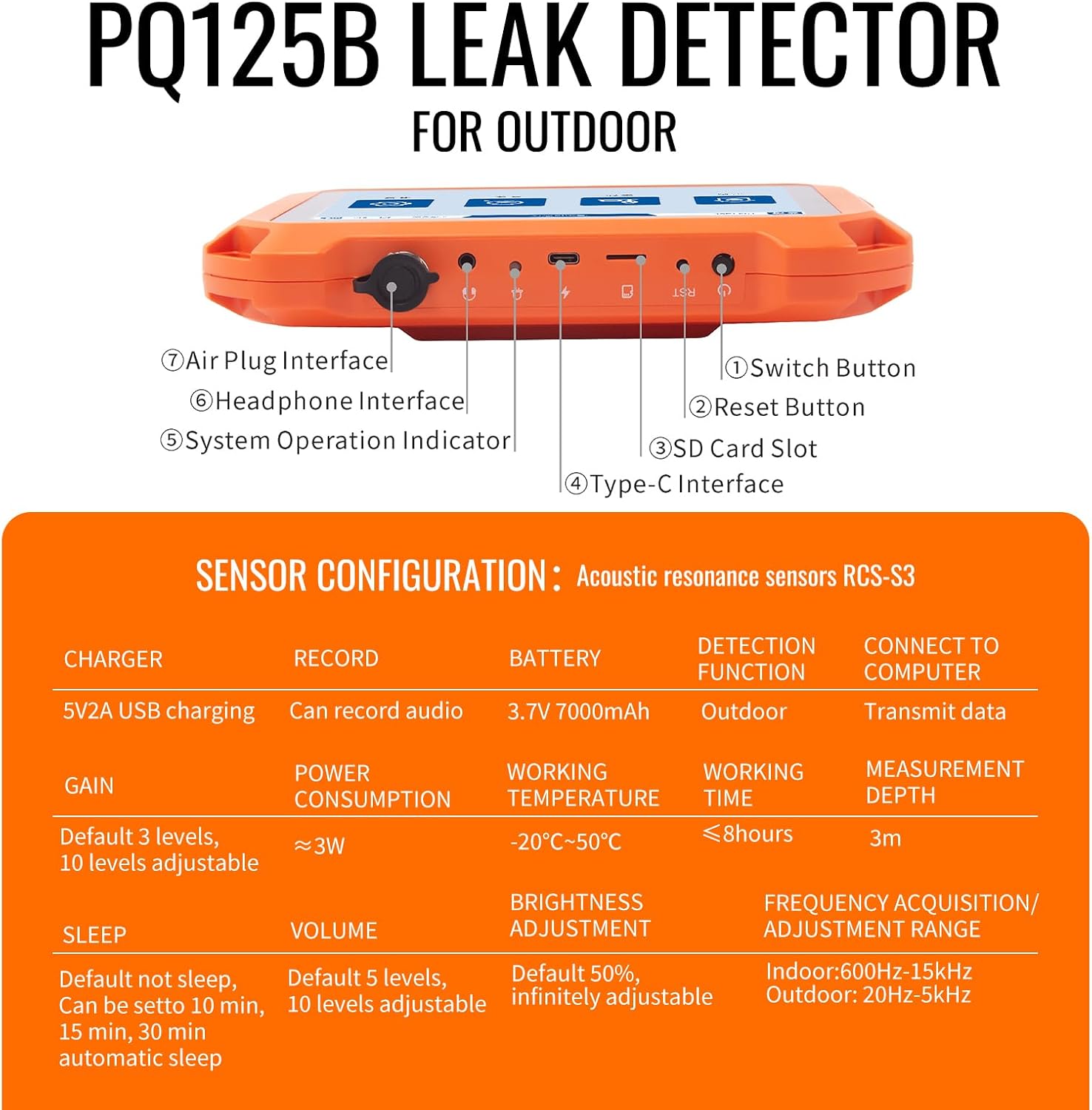
Image: A detailed table showing the sensor configuration and various technical specifications of the PQWT PQ125B Leak Detector, including charging, recording, battery, detection function, working time, and measurement depth.
9. Gwarancja i wsparcie
The main unit of the PQWT PQ125B Water Leak Detector comes with a dwuletnia gwarancja I lifetime maintenance. For any support inquiries, please refer to the contact information provided with your product documentation.
The device interface is available in 12 languages: English, Turkish, Italian, French, Spanish, Arabic, Russian, Korean, German, Portuguese, Polish, Vietnamese.