
Blütezeit ME-EXW50
Blütezeit Automatic Gate Opener Vehicle Exit Sensor
Model: ME-EXW50
Brand: Blütezeit
Wstęp
This instruction manual provides comprehensive guidance for the installation, operation, and maintenance of your Blütezeit Automatic Gate Opener Vehicle Exit Sensor, Model ME-EXW50. This sensor is designed to automatically detect moving vehicles, enabling hands-free gate operation for convenient exit from your property. Please read this manual thoroughly before installation and use to ensure proper function and safety.
Produkt ponadview
The Blütezeit Vehicle Exit Sensor is a robust and reliable solution for automating gate exits. It consists of a durable sensor wand, a pre-wired 50-foot direct-burial cable, and an adjustment board for sensitivity tuning.

Image: The Blütezeit Automatic Gate Opener Vehicle Exit Sensor, showing the sensor wand, the coiled 50-foot cable, and the small green adjustment board with wires.
Kluczowe komponenty:
- Sensor Wand: The primary detection unit, designed for underground burial.
- 50ft Direct-Burial Cable: A heavy-duty cable for connecting the sensor to the gate opener control board.
- Adjustment Board: Used to fine-tune the sensor's detection sensitivity.
Cechy:
- Automatic Vehicle Detection: Triggers gate opener upon vehicle approach.
- Szeroka kompatybilność: Works with most 12–24V AC/DC automatic gate opener systems (e.g., Mighty Mule, Ghost Controls, LiftMaster).
- Easy Underground Setup: 50ft pre-wired cable for flexible installation, requiring shallow burial.
- Regulowana czułość: Detection range from 2–12 feet to prevent false triggers.
- Inteligentna kalibracja: Automatic 60-second calibration after setup or sensitivity adjustment.
- Odporna na warunki atmosferyczne konstrukcja: Waterproof junction box and sealed cable for reliable outdoor performance in various weather conditions (-4°F to 125°F / -20°C to 52°C).
Konfiguracja i instalacja
Prawidłowa instalacja jest kluczowa dla optymalnej wydajności. Postępuj zgodnie z poniższymi krokami.
1. Wybór miejsca:
- Choose a location for the sensor wand approximately 1 to 12 feet from the gate, within the driveway area where vehicles will pass.
- Ensure the chosen spot is clear of large metal objects or electrical lines that could interfere with detection.
2. Burying the Sensor Wand:
- Dig a shallow trench 1–2 inches deep for the sensor wand and its cable.
- Place the sensor wand horizontally in the trench. No loops or ground rods are required.
- Bury the remaining 50-foot cable along the driveway edge towards your gate opener control box.
- Ensure the cable is protected from damage during and after burial.

Image: Diagram showing the Blütezeit Exit Wand buried underground near a driveway, with a car approaching the gate, illustrating its detection capability.
3. Wiring to the Gate Opener:
- Connect the sensor's wires to the appropriate terminals on your gate opener's control board. Refer to your gate opener's manual for specific wiring instructions for vehicle exit sensors or normally open (NO) trigger inputs.
- The sensor supports DC (8–26V AC / 11–30V DC) power inputs.
- Ensure all connections are secure and protected from moisture. The sensor includes a waterproof junction box.
4. Initial Calibration:
- After power-up, the sensor will undergo an automatic 60-second calibration period. During this time, keep the detection area clear of vehicles.
- The sensor will calibrate to its environment, optimizing detection accuracy.
Działanie
Once installed and calibrated, the Blütezeit Vehicle Exit Sensor operates automatically.
Automatyczne wykrywanie:
- When a vehicle approaches the detection zone of the buried sensor, the sensor will detect its presence.
- This detection triggers the connected gate opener, causing the gate to open automatically.
- The system is designed for hands-free exit, eliminating the need for remote controls.

Image: A diagram illustrating the sensor's selective detection. It shows a car activating the gate opener, while a person, animal, or cart does not, preventing false triggers.
Regulowana czułość:
The sensor's detection range can be adjusted from 2 to 12 feet using the adjustment board. This feature helps prevent false triggers from smaller objects like bicycles or lawn equipment.
- Locate the adjustment board (typically found near the gate opener control box).
- Use a small screwdriver to turn the potentiometer on the adjustment board to increase or decrease sensitivity.
- After each adjustment, the sensor will perform a 60-second calibration. Test the detection range with a vehicle to ensure desired performance.
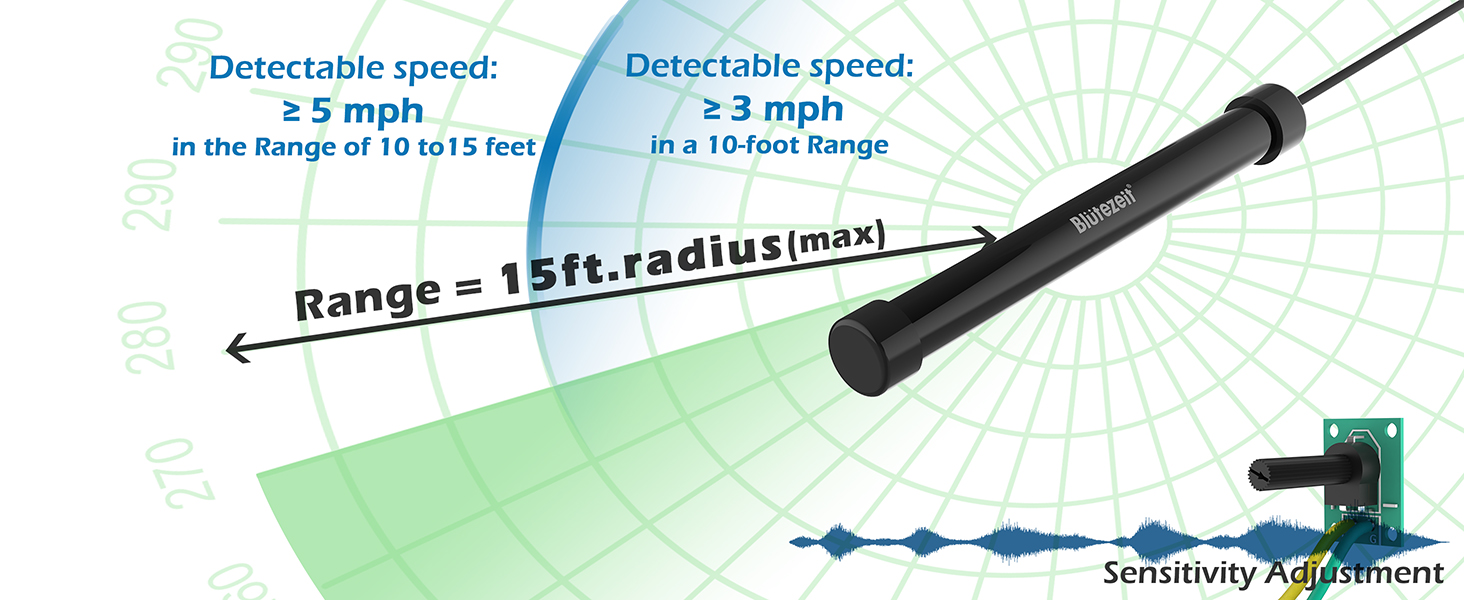
Image: A diagram showing the adjustable detection range of the sensor, indicating detectable speeds at different distances and the location of the sensitivity adjustment on the board.
Zgodność
The Blütezeit Vehicle Exit Sensor is designed for broad compatibility with various automatic gate opener systems.
- Tomtage: Compatible with most 12–24V AC/DC gate opener systems. Supports DC (8–26V AC / 11–30V DC) power inputs.
- Marki: Works seamlessly with popular brands such as Mighty Mule, Ghost Controls, LiftMaster, and other gate opener systems that accept a normally open (NO) trigger input.
- Typy bram: Suitable for both sliding and swing gates.
Konserwacja
The Blütezeit Vehicle Exit Sensor is designed for minimal maintenance due to its durable and weatherproof construction.
- Regularna kontrola: Periodically check the area around the buried sensor for any signs of disturbance or damage to the cable.
- Usuń zanieczyszczenia: Ensure the area above the sensor is clear of excessive debris, heavy snow, or ice that might impede detection, although the sensor is designed to detect through shallow ground cover.
- Integralność kabla: Inspect the cable connections at the gate opener control box for corrosion or loose wiring.
Rozwiązywanie problemów
If you experience issues with your Blütezeit Vehicle Exit Sensor, consider the following common solutions:
- Gate Not Opening:
- Verify power supply to the gate opener and sensor.
- Check all wiring connections for security and proper polarity.
- Ensure the sensor's detection area is clear during the 60-second calibration period.
- Adjust sensitivity settings on the adjustment board. If sensitivity is too low, the sensor may not detect vehicles.
- Confirm the sensor is buried at the recommended depth (1-2 inches) and distance from the gate (1-12 feet).
- False Triggers (Gate Opens Unintentionally):
- Reduce the sensitivity setting on the adjustment board.
- Ensure the sensor is not too close to the gate or other large metal objects.
- Confirm no other magnetic or electrical interference sources are nearby.
- Działanie przerywane:
- Inspect the cable for any damage or breaks, especially if buried in an area prone to digging or heavy traffic.
- Check for loose connections at the gate opener control board.
- Ensure the operating temperature is within the specified range (-4°F to 125°F).
If issues persist after attempting these troubleshooting steps, please contact Blütezeit technical support for assistance.
Specyfikacje
| Numer modelu | ME-EXW50 |
| Waga przedmiotu | 5.14 funta |
| Wymiary produktu | 16.54 x 7 x 3.94 cala |
| Zawarte komponenty | 1 × Adjustment Board with Cable, 1 × Sensor with 50ft Direct-Burial Cable |
| Moc wejściowa | 8–26V AC / 11–30V DC |
| Zasięg wykrywania | Adjustable 2–12 feet |
| Temperatura pracy | -4°F do 125°F (-20°C do 52°C) |
Gwarancja i wsparcie
The Blütezeit Automatic Gate Opener Vehicle Exit Sensor (Model ME-EXW50) comes with a 12-miesięczna gwarancja od daty zakupu, obejmującej wady materiałowe i wykonawcze.
For technical assistance, troubleshooting, or warranty claims, please contact Blütezeit's U.S.-based technical support. Lifetime support is provided for this product.
Contact information can typically be found on the Blütezeit official webna stronie lub w dokumentacji zakupu.
Ask a question about this manual
Ask about setup, troubleshooting, compatibility, parts, safety, or missing instructions. Manuals+ will review the question and use this page’s manual context to help answer it.