1. Wprowadzenie
This manual provides essential information for the proper use and integration of the Generic VGdd79S915N0S1 LoRa Module. This module is a compact, surface-mount device designed for long-range, low-power wireless communication at 915MHz, utilizing the LLCC68 chipset. It is intended for developers and engineers integrating LoRa capabilities into their projects.
2. Główne cechy
- LoRa wireless communication technology for long-range applications.
- Operating frequency: 915MHz, suitable for regions supporting this band.
- Integrated Semtech LLCC68 chipset for robust performance.
- Surface Mount Device (SMD) form factor for compact PCB integration.
- Compact dimensions: 11.5mm x 11.5mm.
3. Specyfikacje techniczne
| Parametr | Wartość |
|---|---|
| Numer modelu | VGdd79S915N0S1 |
| Częstotliwość pracy | 915MHz |
| Zestaw układów scalonych | LLCC68 |
| Współczynnik kształtu | SMD (urządzenie do montażu powierzchniowego) |
| Wymiary | 11.5mm x 11.5mm |
| Producent | Ogólny |
| ASIN | B0F1818TXS |
| Pierwsza dostępna data | 12 marca 2025 r. |
4. Koniec produktuview
The following images provide a visual representation of the VGdd79S915N0S1 LoRa module, highlighting its physical characteristics and pinout.

Obraz 1: Szczyt view of the VGdd79S915N0S1 LoRa module, showing its compact size and integrated shielding. This perspective highlights the module's overall form factor.
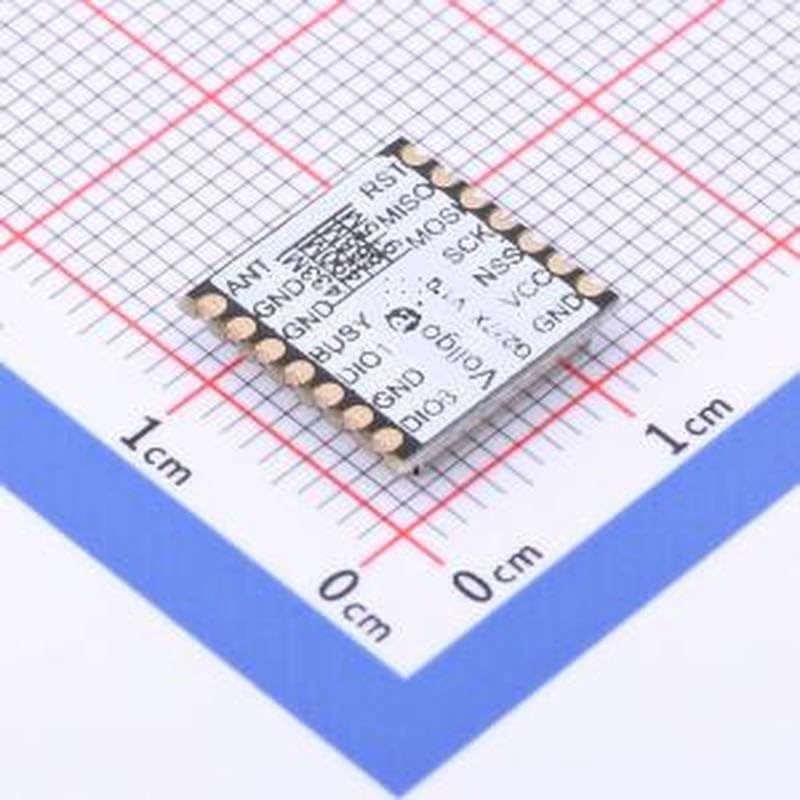
Obraz 2: Spód view of the VGdd79S915N0S1 LoRa module, illustrating the pinout configuration (ANT, GND, RST, MISO, MOSI, SCK, NSS, BUSY, DIO1, DIO3, VCC, GND) against a 1cm grid for scale. This view is crucial for proper PCB design and connection.
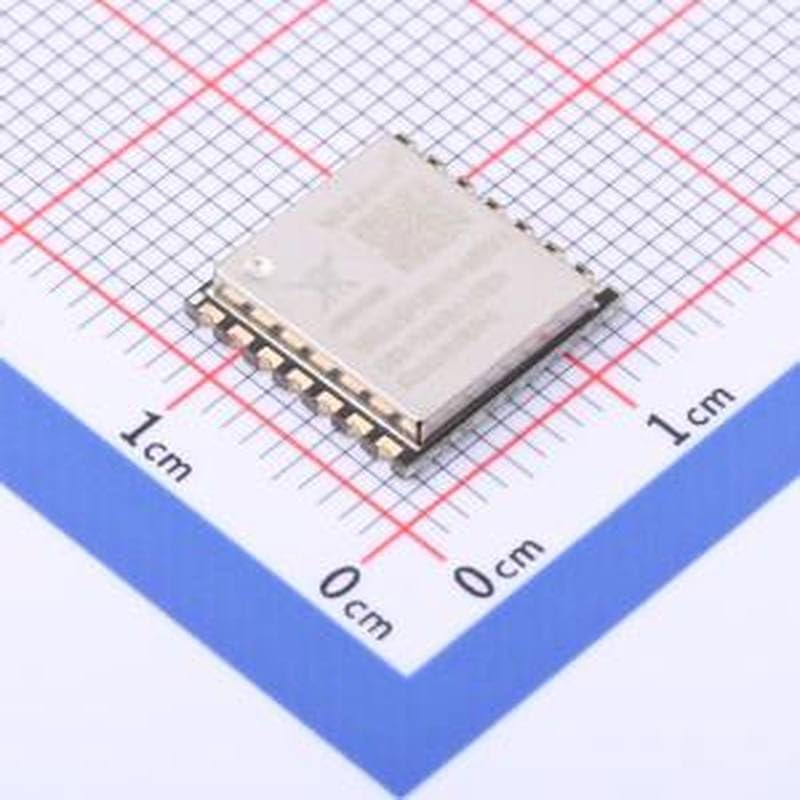
Obraz 3: Kątowy view of the VGdd79S915N0S1 LoRa module, demonstrating its small footprint and surface-mount pads on a measurement grid. This provides a three-dimensional perspective of the module's physical design.
5. Konfiguracja i integracja
Integrating the VGdd79S915N0S1 LoRa module requires careful attention to power supply, antenna connection, and communication interfaces. This module is designed for surface mounting onto a Printed Circuit Board (PCB).
5.1. Zasilanie
- Ensure a stable and clean power supply within the module's specified voltage range. Refer to the LLCC68 datasheet for exact voltagi wymagania.
- Proper decoupling capacitors should be placed as close as possible to the VCC pin to filter noise and ensure stable operation.
5.2. Podłączenie anteny
- Connect a 915MHz antenna to the ANT pin. The antenna must be matched to 50 ohms for optimal radio frequency (RF) performance.
- Avoid placing other components, ground planes, or metal objects directly under the antenna trace or near the antenna itself to prevent signal interference and degradation.
5.3. Interfejs komunikacyjny
- The module typically communicates with a host microcontroller via SPI (Serial Peripheral Interface). Connect the MOSI, MISO, SCK, and NSS pins to your microcontroller's corresponding SPI pins.
- The RST (Reset), BUSY, DIO1, and DIO3 pins provide control and status signals. Refer to the LLCC68 datasheet for detailed pin functions and recommended connection schemes for your application.
5.4. Lutowanie
- As an SMD component, the module requires reflow soldering. Follow standard SMD soldering profiles to prevent damage to the module.
- Ensure correct pad alignment and sufficient, but not excessive, solder paste application for reliable electrical and mechanical connections.
6. Zasady działania
The VGdd79S915N0S1 LoRa module operates based on Semtech's LoRa technology, providing long-range, low-power wireless data transmission. Understanding its basic operation is crucial for application development.
6.1. LoRa Technology
- LoRa (Long Range) is a proprietary spread spectrum modulation technique derived from chirp spread spectrum (CSS) technology.
- It enables long-range communication with high interference immunity while minimizing power consumption, making it ideal for IoT applications.
6.2. Transmisja danych
- Data is transmitted by configuring the module's internal registers via the SPI interface. Parameters such as frequency, spreading factor, bandwidth, and coding rate must be set according to your communication requirements.
- The LLCC68 chipset handles the complex LoRa modulation and demodulation processes internally, simplifying the host microcontroller's task.
6.3. Packet Mode
- The LLCC68 chipset supports various packet modes, including explicit and implicit header modes, Cyclic Redundancy Check (CRC) functionality, and different payload lengths.
- Refer to the official LLCC68 datasheet for detailed register configurations and programming examples to implement specific packet structures.
7. Konserwacja
The VGdd79S915N0S1 LoRa module is a robust electronic component designed for long-term operation with minimal maintenance. However, certain practices can ensure its longevity and reliable performance.
- Warunki środowiskowe: Operate the module within its specified temperature and humidity ranges. Avoid exposure to extreme temperatures, high moisture, or corrosive environments, which can degrade performance and lifespan.
- Obsługa fizyczna: Handle the module with care to prevent physical damage to the pins or the ceramic package. Always use anti-static precautions (e.g., ESD wrist strap) when handling to avoid electrostatic discharge, which can damage sensitive internal circuitry.
- Czyszczenie: If cleaning is necessary, use a soft, dry brush or compressed air to remove dust and debris. Avoid liquid cleaners unless specifically designed for electronic components and applied sparingly, ensuring no residue is left behind.
- Aktualizacje oprogramowania układowego: While the module itself does not typically have user-updatable firmware, ensure that the firmware of the host microcontroller interacting with the module is kept up-to-date for optimal performance, security, and compatibility with the LoRa module.
8. Rozwiązywanie Problemów
If you encounter issues with the VGdd79S915N0S1 LoRa module, consider the following common troubleshooting steps.
8.1. No Communication with Microcontroller
- Sprawdź okablowanie: Verify all SPI connections (MOSI, MISO, SCK, NSS) and power supply (VCC, GND) are correctly wired and securely connected. Loose connections are a common cause of communication failure.
- Zasilanie: Ensure the module is receiving the correct voltage and current. Measure voltage at the VCC pin to confirm it is within the specified operating range.
- Resetuj PIN: Confirm the RST pin is correctly controlled by the microcontroller and is not inadvertently held in a reset state.
- SPI Configuration: Double-check your microcontroller's SPI settings (e.g., clock polarity, clock phase, bit order, clock speed) match the module's requirements as specified in the LLCC68 datasheet.
8.2. Poor Wireless Range or Connectivity
- Antena: Ensure a 915MHz antenna is properly connected and matched to 50 ohms. A poorly matched, incorrect, or damaged antenna can severely degrade RF performance.
- Ingerencja: Check for potential sources of interference in the 915MHz band (e.g., other wireless devices, industrial equipment, strong electromagnetic fields).
- Linia wzroku: LoRa performance is best with clear line of sight between transmitting and receiving modules. Obstructions like walls, buildings, or terrain can significantly reduce range.
- Konfiguracja modułu: Verify LoRa parameters (spreading factor, bandwidth, coding rate, transmit power) are optimally configured for your specific application and environmental conditions. Suboptimal settings can impact range and reliability.
8.3. Przegrzanie modułu
- Zasilanie: Upewnij się, że głośność wejściowatage is within the specified range. Overvoltage can cause the module to draw excessive current and generate heat.
- Transmit Duty Cycle: Continuous high-power transmission can generate significant heat. Ensure your application adheres to local regulations regarding transmit duty cycle and consider implementing appropriate cooling if necessary.
- Temperatura otoczenia: Operate the module within its specified ambient temperature range. High ambient temperatures can contribute to overheating.
9. Gwarancja i wsparcie
As a Generic product, specific warranty details may vary. Please refer to your point of purchase or the seller for information regarding warranty coverage and technical support for the VGdd79S915N0S1 LoRa Module.
For detailed technical specifications, register descriptions, and programming guides related to the LLCC68 chipset, please consult the official Semtech LLCC68 datasheet and application notes, which are the primary resources for in-depth technical information.
