
1. Wprowadzenie
This manual provides detailed instructions for the setup, operation, and maintenance of your AHXJKA 15.6-inch Portable Touchscreen Monitor (Model S150T). Please read this manual thoroughly before using the product to ensure proper functionality and to maximize your user experience.

Image: The AHXJKA 15.6-inch Portable Touchscreen Monitor in use, displaying a media player. The monitor is set up on its smart cover case, acting as a stand.
2. Główne cechy
- 15.6-calowy ekran dotykowy Full HD: Features a 1920x1080 resolution with touch capability, providing an interactive display.
- IPS/HDR Technology: Equipped with IPS and HDR for vibrant colors and wide viewkąty.
- Lekkie i wytrzymałe: Weighs approximately 1.74 lbs and includes a smart cover case for portability and protection.
- Wszechstronna łączność: Includes two Type-C ports, a mini HDMI port, and a 3.5mm audio jack for connecting to various devices.
- Wbudowane głośniki: Equipped with 8Ω/1W*2 speakers for integrated audio.

Image: Visual representation of the monitor's display characteristics, highlighting brightness, contrast, color depth, low blue light feature, and wide viewkąt.

Obraz: Byłyamples of the monitor's versatile applications, including collaborative work, financial analysis, and gaming entertainment.
3. Co znajduje się w pudełku
Sprawdź, czy w opakowaniu znajdują się wszystkie elementy:
- AHXJKA Portable Monitor
- Monitor Stand (Smart Cover Case)
- Instrukcja obsługi
- Kabel mini HDMI do HDMI
- Kabel typu C do typu C

Image: All components included in the AHXJKA Portable Monitor package.
4. Konfiguracja i połączenie
The AHXJKA portable monitor offers multiple connection options for various devices. Ensure your device supports the necessary output for video and touch functionality.
4.1. Koniec łącznościview

Obraz: Ponadview of available cables and connection methods for laptops.

Obraz: Szczegółowy view of the monitor's ports and controls, indicating compatibility with smartphones, tablets, laptops, PCs, Switch, Camera, Xbox, Raspberry Pi, and Computer.
4.2. Enabling Touch Functionality
For touch functionality, a specific USB-C connection is required in addition to the video signal. Ensure any protective film is removed from the screen for optimal touch response.
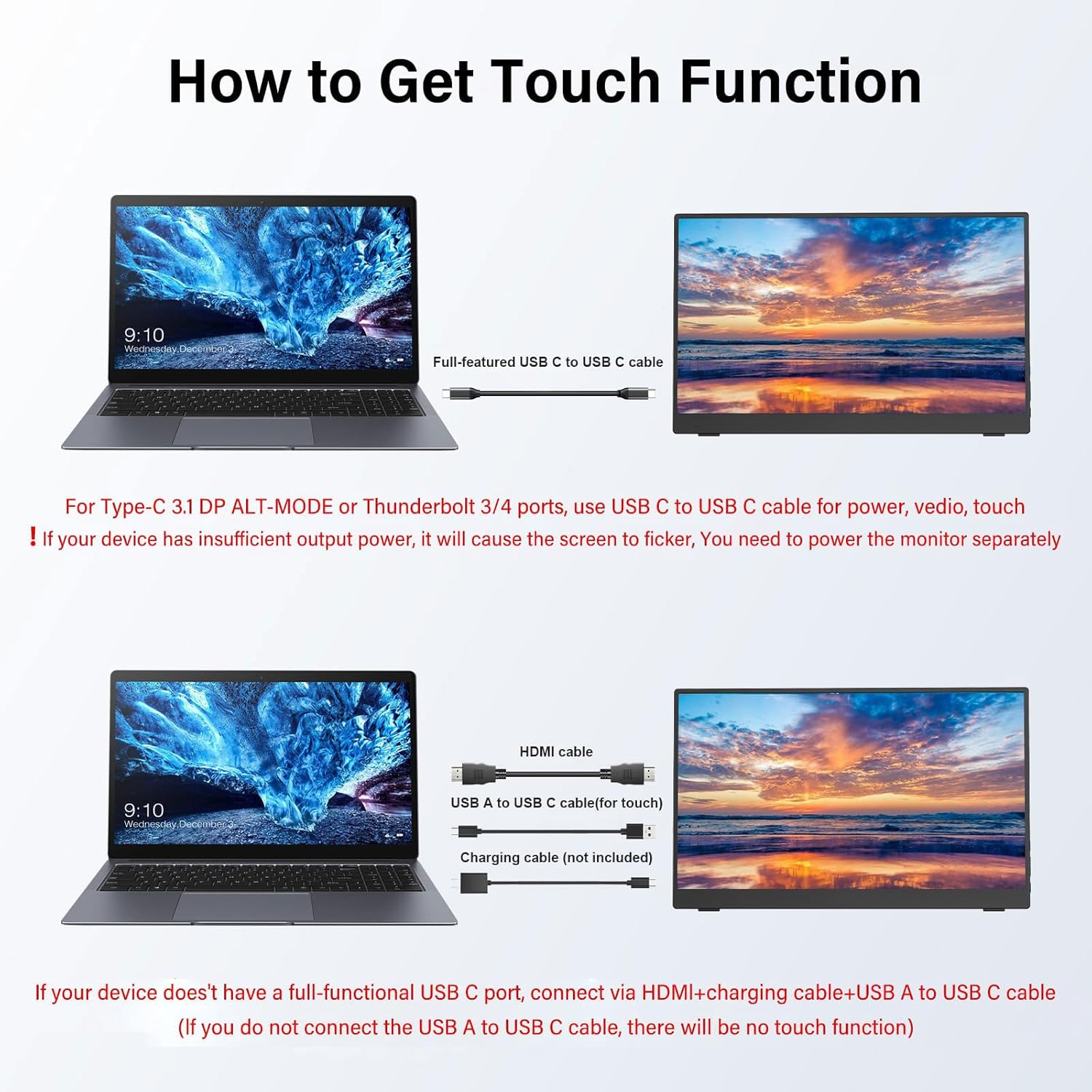
Image: Instructions for enabling touch functionality via USB-C or HDMI with a separate USB-A to USB-C cable.
4.3. Metody połączenia
Below are common connection methods for your portable monitor:
4.3.1. HDMI Connection (for Video)
Connect the monitor to your laptop or PC using the Mini HDMI to HDMI cable for video output. For touch functionality, an additional USB-A to Type-C cable must be connected from your computer to the monitor's Type-C port. Power can be supplied via a separate USB-A to Type-C cable connected to a power adapter or your computer's USB port.
Video: Demonstrates connecting the monitor to a laptop via HDMI for video and a USB-A to Type-C cable for touch input, along with a separate power connection.
4.3.2. Type-C Connection (Full-Featured)
If your device (laptop, smartphone, or tablet) has a full-featured USB-C port (supporting DisplayPort Alt Mode and power delivery), you can connect it to the monitor using a single Type-C to Type-C cable. This cable will transmit video, audio, touch data, and power simultaneously. If your device's USB-C port does not provide sufficient power, you may need to connect an additional USB-A to Type-C cable to a power adapter for external power.
Video: Illustrates connecting the monitor to a laptop using a single Type-C cable for video, touch, and power, and also shows phone connection.
4.3.3. Połączenie ze smartfonem
For smartphones with full-featured USB-C ports, connect using a Type-C to Type-C cable. This enables screen mirroring or extended display with touch functionality. Ensure your phone supports video output over USB-C. If the phone cannot power the monitor, use an external power source connected to the monitor's charging port.
Video: Demonstrates connecting a smartphone to the portable monitor via a Type-C cable, showcasing screen mirroring and touch interaction.
5. Instrukcja obsługi
5.1. Włączanie/wyłączanie zasilania i nawigacja po menu
- Power Button/Return: Press and hold to power the monitor on or off. During menu navigation, a short press acts as a 'Return' or 'Back' function.
- Przycisk MENU: Press to access the On-Screen Display (OSD) menu.
- Dostosowania: To adjust brightness, press the Power Button/Return upwards. To adjust volume, press downwards. If both need simultaneous adjustment, adjust one first, then use the MENU button to switch to the other setting.
5.2. Touchscreen Functions
The monitor supports multi-touch gestures for intuitive interaction:
- Pojedynczy dotyk: Tap to select or activate items.
- Wielodotykowy: Use multiple fingers for specific actions (e.g., two-finger scroll).
- Sterowanie suwakiem: Drag a finger across the screen to scroll or move items.
- Kontrola zoomu: Use a pinch-to-zoom gesture with two fingers to enlarge or reduce content.

Image: Illustration of ten-point touch capabilities and various control gestures.

Image: Demonstrates touch, click, enlarge, and pinch gestures on the monitor.
6. Konserwacja i pielęgnacja
- Czyszczenie ekranu: Użyj miękkiej, niestrzępiącej się ściereczki, lekko wyczyśćampened with water or a screen cleaner. Avoid harsh chemicals, alcohol, or abrasive materials.
- Czyszczenie Casing: Wytrzyj monitor casinmiękką, suchą szmatką.
- Składowanie: When not in use, store the monitor in its protective smart cover case to prevent scratches and damage. Avoid exposing it to extreme temperatures or humidity.
- Obsługiwanie: Obchodź się z monitorem ostrożnie. Unikaj upuszczania go i wywierania nadmiernego nacisku na ekran.
7. Rozwiązywanie Problemów
Jeśli masz problemy z monitorem, zapoznaj się z poniższymi typowymi rozwiązaniami:
- Brak sygnału/czarny ekran:
- Ensure all cables (HDMI, Type-C) are securely connected to both the monitor and the source device.
- Verify the source device is powered on and configured to output video to an external display.
- Check if the monitor is receiving sufficient power. Connect an external power adapter if using HDMI or if the Type-C source cannot provide enough power.
- Wypróbuj inny kabel lub port zarówno w monitorze, jak i w urządzeniu źródłowym.
- Funkcja dotykowa nie działa:
- Ensure the correct USB-C connection for touch data is established (either a full-featured Type-C cable or a separate USB-A to Type-C cable for touch).
- Remove any screen protectors that may interfere with touch sensitivity.
- Verify that your source device (laptop, phone) supports touch input to an external monitor and that the necessary drivers are installed (for Windows PCs).
- Upewnij się, że monitor otrzymuje odpowiednie zasilanie.
- Migotanie ekranu:
- This often indicates insufficient power. Connect the monitor to an external power adapter using the provided USB-A to Type-C charging cable.
- Sprawdź, czy kabel wideo nie jest uszkodzony i jest prawidłowo podłączony.
- Brak dźwięku:
- Check the monitor's volume settings via the OSD menu.
- Ensure your source device's audio output is directed to the external monitor.
- If using the 3.5mm audio jack, ensure headphones or speakers are properly connected.
- Problemy z jakością obrazu (rozmazany, zniekształcony):
- Adjust the resolution and refresh rate settings on your source device to match the monitor's native resolution (1920x1080).
- Sprawdź, czy kabel wideo nie jest uszkodzony lub czy połączenia nie są luźne.
8. Specyfikacje
| Marka | AHXJKA |
| Numer modelu | S150T |
| Rozmiar ekranu | 15.6 cali |
| Rezolucja | 1920 x 1080 pikseli (FHD 1080p) |
| Proporcje obrazu | 16:9 |
| Typ panelu | IPS |
| Obsługa HDR | Tak |
| Ekran dotykowy | Yes (10-point touch) |
| Jasność obrazu | 250 cd/m² |
| Współczynnik kontrastu | 1000:1 |
| Głębia koloru | 16.7 milionów kolorów |
| Powierzchnia ekranu | Matowy |
| Wymiary produktu | 0.4 x 8.69 x 13.9 cala |
| Waga przedmiotu | 3.39 funta |
| Wbudowane głośniki | 8 Ω/1 W*2 |
| Łączność | 2x Type-C (Full-featured), 1x Mini HDMI, 1x 3.5mm Audio Jack |
9. Gwarancja i wsparcie
For warranty information and technical support, please refer to the warranty card included in your product packaging or contact AHXJKA customer service through the official channels provided at the time of purchase. Please have your model number (S150T) and purchase details ready when contacting support.