
1. Wprowadzenie
The Waveshare RP2350 MCU Board is a high-performance microcontroller unit featuring a 1.28-inch capacitive touch display. This board integrates a Li-ion battery recharge manager and a 6-axis sensor (3-axis accelerometer and 3-axis gyroscope), making it suitable for various embedded applications. It is based on the Raspberry Pi RP2350 microcontroller chip, which utilizes a unique dual-core and dual-architecture design.
This manual provides essential information for setting up, operating, and maintaining your RP2350 MCU Board.
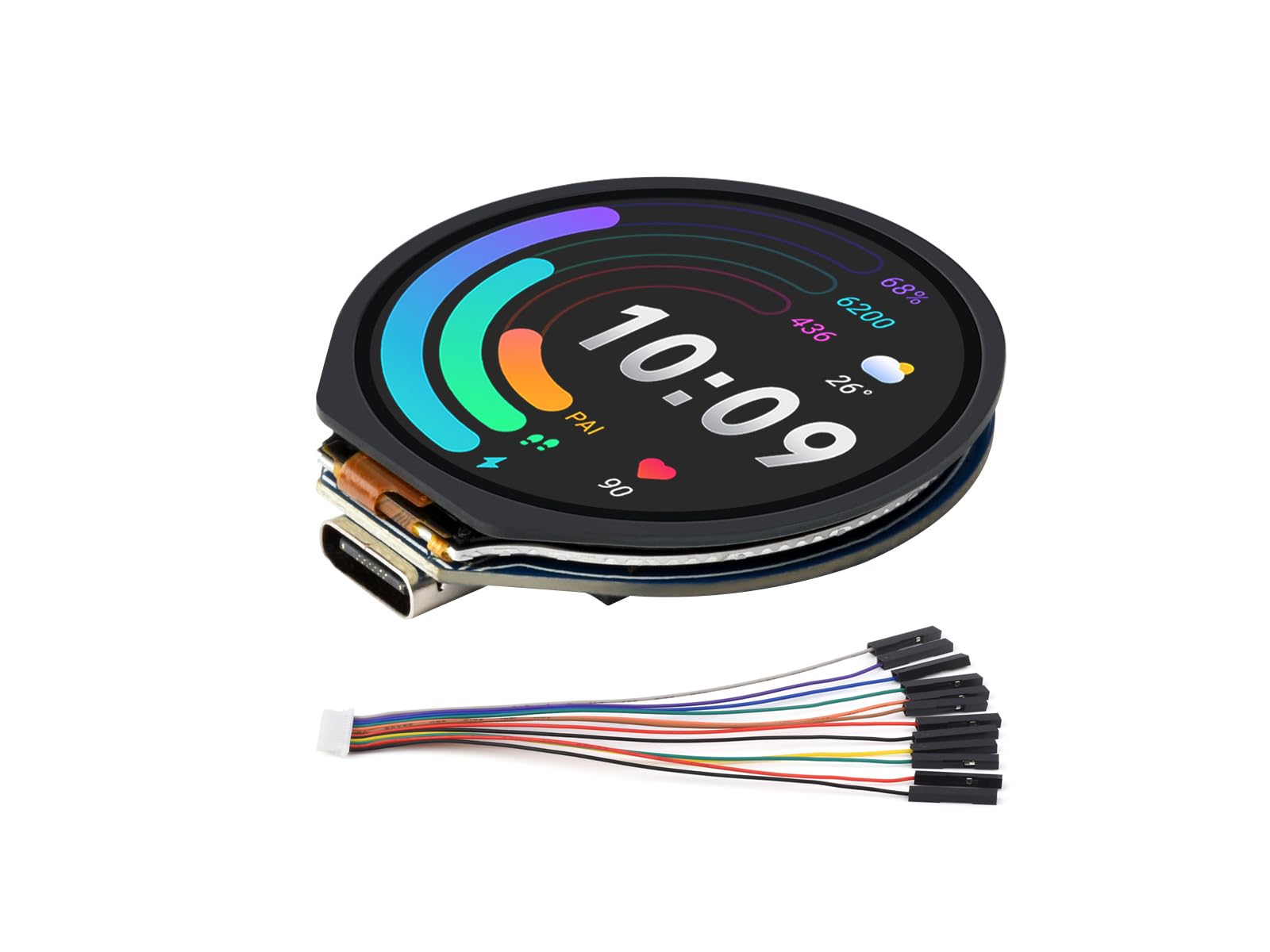
Image: The Waveshare RP2350 MCU Board, highlighting its 1.28-inch touch display, Type-C port, dual-core architecture, and 65K color support.
2. Główne cechy
- mikrokontrolery: Based on Raspberry Pi RP2350 chip with dual-core Arm Cortex-M33 and dual-core Hazard3 RISC-V processors, clock up to 150 MHz.
- Pamięć: 520KB SRAM and 16MB onboard Flash memory.
- Wyświetlacz: Integrated 1.28-inch capacitive touch LCD with 240×240 pixels and 65K color support.
- Łączność: Type-C USB 1.1 connector with device and host support.
- Zarządzanie energią: Lithium battery recharge/discharge header for mobile applications.
- Czujniki: Onboard 6-axis sensor (3-axis accelerometer and 3-axis gyroscope).
- GPIO: 6 × GPIO pins available via SH1.0 connector.
- Programowanie: Supports drag-and-drop programming via USB mass storage, C/C++, MicroPython, and Arduino.
- Dodatkowe funkcje: Low-power sleep and dormant modes, accurate clock and timer, temperature sensor.
3. Zawartość opakowania
Sprawdź, czy w przesyłce znajdują się wszystkie elementy wymienione poniżej:
- RP2350-Touch-LCD-1.28 Board x1
- Kabel SH1.0 12PIN x1
4. Koniec sprzętuview
The following diagram illustrates the main components and interfaces of the RP2350 MCU Board.
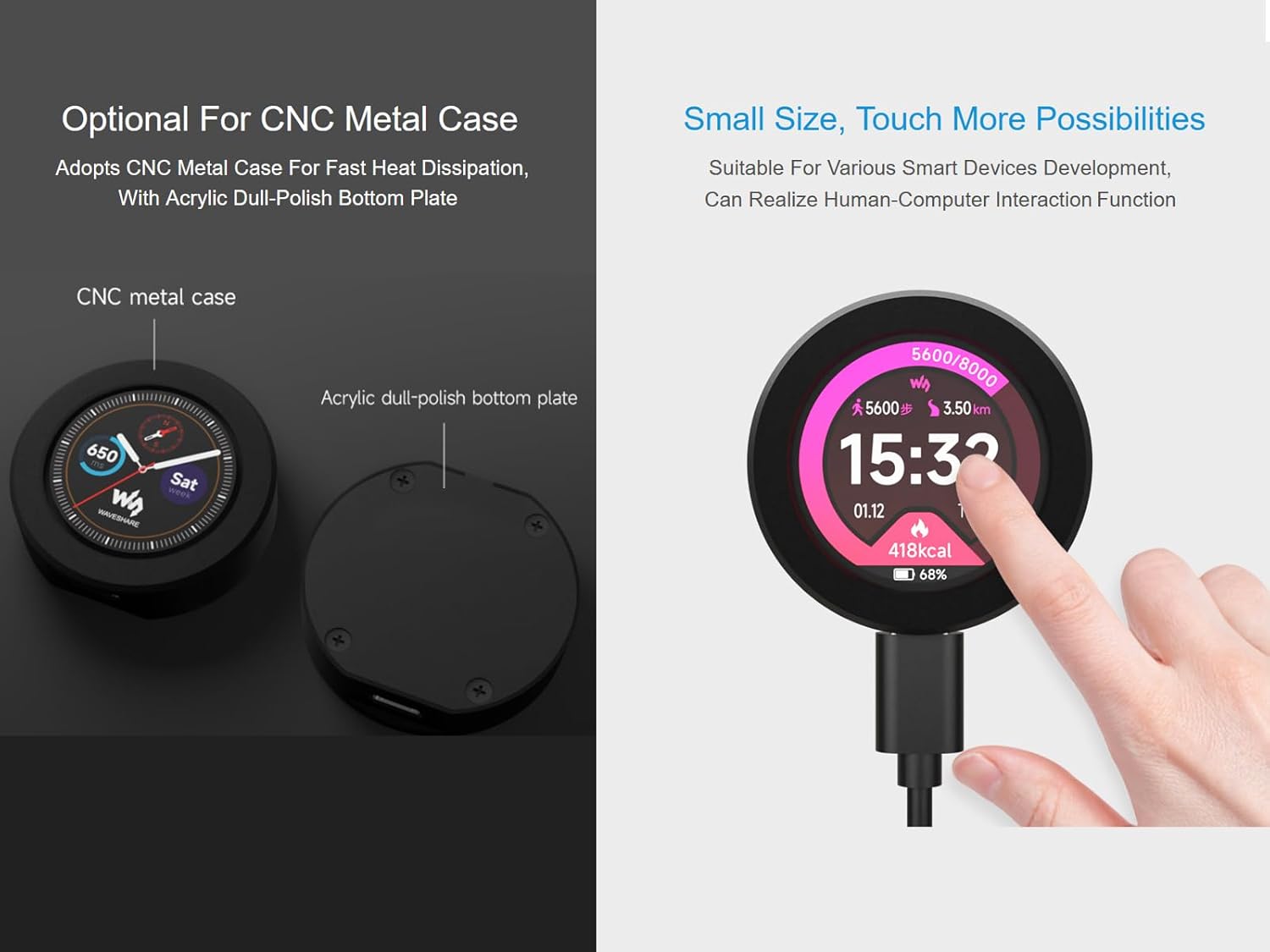
Image: RP2350 MCU Board with key components labeled for identification.
- Złącze USB typu C: For program burning and USB 1.1 communication (device and host support).
- ETA6098: High-efficiency Lithium battery recharge manager.
- RT9193-33PB: 300mA low dropout, low noise, ultra-fast LDO.
- W25Q128JVSIQ: Pamięć NOR-Flash 16MB.
- RP2350: Konstrukcja dwurdzeniowa i o podwójnej architekturze, częstotliwość robocza do 150 MHz.
- QMI8658: 6-axis IMU (3-axis gyroscope and 3-axis accelerometer).
- Przycisk BOOT: Naciśnij podczas resetowania, aby przejść do trybu pobierania.
- Przycisk reset: Resetuje planszę.
- MX1.25 2P battery header: Do baterii litowych 3.7 V. Obsługuje ładowanie i rozładowywanie.
5. Definicja pinów
Understanding the pinout is crucial for connecting peripherals and developing applications. The following diagram details the pin assignments for the RP2350 MCU Board.

Image: Pinout diagram for the RP2350 MCU Board, showing GPIO, power, and system control pins.
Key pin categories include:
- Moc: VBUS, 3V3, 3V3_EN, VSYS
- Grunt: GND
- GPIO, PIO and PWM: GPIO0-GPIO29 (specific pins are highlighted in the diagram)
- Kontrola systemu: RUN, BOOT, RESET
6. Instrukcje konfiguracji
6.1 Połączenie początkowe
- Connect the RP2350 MCU Board to your computer using a Type-C USB cable.
- Ensure the board powers on. The integrated display should illuminate.
- For initial programming, you may need to press and hold the URUCHOMIĆ button while connecting the USB cable, then release it. This will put the board into USB mass storage mode, allowing you to drag-and-drop firmware files.
6.2 Instalacja sterownika
Typically, the RP2350 board will be recognized as a mass storage device or a serial port without requiring specific drivers on most modern operating systems (Windows, macOS, Linux). If issues arise, refer to the official Raspberry Pi Pico 2 documentation for driver information.
6.3 Zasilanie płyty
- Zasilanie USB: The board can be powered directly via the Type-C USB port.
- Moc baterii: Connect a 3.7V Lithium battery to the MX1.25 2P battery header. The onboard ETA6098 chip manages battery charging and discharging.
7. Instrukcja obsługi
7.1 Programowanie płytki
The RP2350 MCU Board supports multiple programming methods:
- Drag-and-Drop (UF2): When the board is in bootloader mode (hold BOOT, then connect USB), it appears as a USB mass storage device. You can drag and drop UF2 firmware files directly onto this drive to program the board.
- SDKs: Utilize the official C/C++ SDK, MicroPython, or Arduino IDE for more advanced development. Refer to the respective documentation for detailed instructions on setting up your development environment.
7.2 Using the Touch Display
The 1.28-inch capacitive touch display allows for interactive applications. Your custom firmware will define the display's content and touch response. Example code and libraries are typically available in the Waveshare development resources to assist with display initialization and graphic rendering.

Image: The RP2350 MCU Board's 1.28-inch touch display showing a graphical user interface, demonstrating its interactive capabilities.
7.3 Utilizing Onboard Sensors
The integrated 6-axis IMU (accelerometer and gyroscope) can be accessed via I2C or SPI interfaces, depending on the specific sensor and library used. Consult the Waveshare documentation or sensor datasheet for programming examples to read sensor data.
8. Development Environment Support
The RP2350 MCU Board offers broad compatibility with popular development tools:

Obraz: Ponadview of supported development environments: Pico C/C++ SDK, MicroPython, and Arduino IDE.
8.1 Pico C/C++ SDK
The official Raspberry Pi C/C++ SDK can be used for bare-metal programming. It supports command-line compilation and integration with popular IDEs like Visual Studio Code and Eclipse.
8.2 MicroPython
MicroPython provides a Python 3 implementation optimized for embedded hardware. It allows for rapid development and prototyping on the RP2350 board.
8.3 Arduino IDE
The Arduino IDE offers a user-friendly environment for programming. With the appropriate board package installed, you can leverage Arduino's extensive libraries and community support.
9. Specyfikacje techniczne
| Mikrokontrolery | Raspberry Pi RP2350 (Dual-core Arm Cortex-M33 & Dual-core Hazard3 RISC-V) |
| Prędkość zegara | Do 150 MHz |
| Pamięć RAM | 520 KB |
| Pamięć Flash | 16 MB (onboard) |
| Wyświetlacz | 1.28-inch Capacitive Touch LCD, 240×240 pixels, 65K colors |
| Interfejs USB | Type-C, USB 1.1 (device and host support) |
| Czujniki | 6-axis IMU (3-axis accelerometer, 3-axis gyroscope) |
| Wsparcie baterii | 3.7V Lithium battery (recharge/discharge manager onboard) |
| Piny GPIO | 6 × GPIO via SH1.0 connector |
| Wsparcie systemu operacyjnego | Linux (as per product data, likely referring to development host OS) |
| Technologia łączności | USB |
| Kompatybilne urządzenia | USB devices (e.g., keyboards, mice, storage devices), Arduino, Raspberry Pi models, SH1.0 compatible devices |
10. Wymiary obrysu
The physical dimensions of the RP2350 MCU Board are provided below for integration into projects and enclosures.

Image: Detailed outline dimensions of the RP2350 MCU Board, including measurements for the board itself and with an optional metal case (units in millimeters).
Wszystkie wymiary podano w milimetrach (mm).
- Board Diameter: Około 38.51 mm
- Średnica wyświetlacza: Approximately 33.40 mm (VA area)
- Grubość płyty: Approximately 7.48 mm (excluding connectors)
- With Metal Case: Diameter approximately 48.0 mm, Thickness approximately 9.5 mm
11. Rozwiązywanie Problemów
If you encounter issues with your RP2350 MCU Board, consider the following troubleshooting steps:
- Płyta nie włącza się:
- Upewnij się, że kabel USB jest prawidłowo podłączony do płytki i źródła zasilania/komputera.
- Spróbuj użyć innego kabla USB lub portu USB.
- If using battery power, verify the battery is charged and correctly connected to the MX1.25 2P header.
- Płyta nie została rozpoznana przez komputer:
- Try connecting the board while holding the URUCHOMIĆ button to enter mass storage mode.
- Upewnij się, że sterowniki USB Twojego systemu operacyjnego są aktualne.
- Uruchom ponownie komputer.
- Wyświetlacz nie działa:
- Check for any visible damage to the display or its connector.
- Verify that your firmware includes the necessary display initialization code.
- Ensure sufficient power is supplied to the board.
- Błędy programowania:
- Sprawdź dokładnie swój kod pod kątem błędów składniowych i błędów logicznych.
- Ensure the correct board and port are selected in your IDE (if applicable).
- Refer to the specific SDK or IDE documentation for common programming issues.
- Nieoczekiwane zachowanie:
- Perform a hard reset using the NASTAWIĆ przycisk.
- Re-flash a known working firmware to rule out software issues.
- Check for short circuits or incorrect wiring if external components are connected.
12. Konserwacja
To ensure the longevity and optimal performance of your RP2350 MCU Board, follow these maintenance guidelines:
- Składowanie: Przechowuj płytkę w suchym, antystatycznym miejscu, z dala od bezpośredniego światła słonecznego i ekstremalnych temperatur.
- Czyszczenie: Use a soft, dry brush or compressed air to remove dust. For stubborn dirt, use a lint-free cloth lightly dampened with isopropyl alcohol. Ensure the board is powered off and completely dry before re-applying power.
- Obsługiwanie: Always handle the board by its edges to avoid touching sensitive components. Use anti-static precautions when working with the board.
- Aktualizacje oprogramowania układowego: Regularnie sprawdzaj oficjalną stronę Waveshare website or relevant community forums for firmware updates and bug fixes to ensure your board runs with the latest improvements.
13. Wsparcie techniczne i zasoby
For further assistance, development resources, and technical support, please refer to the official Waveshare documentation and support channels. Online development resources and tutorials are available to help you get started and resolve any issues.
You can typically find detailed guides, example code, and community forums on the Waveshare official webstrona.