
Wstęp
The AKG C 451 B is a small-diaphragm condenser microphone, known for its clear and airy sound. It is a modern iteration of the classic C451 EB + CK1 capsule, first introduced in 1969. This microphone is designed for high-quality audio capture, offering a high overload limit and robust construction suitable for various recording environments, including demanding live sound applications. Its low-noise preamp electronics ensure reliable performance.
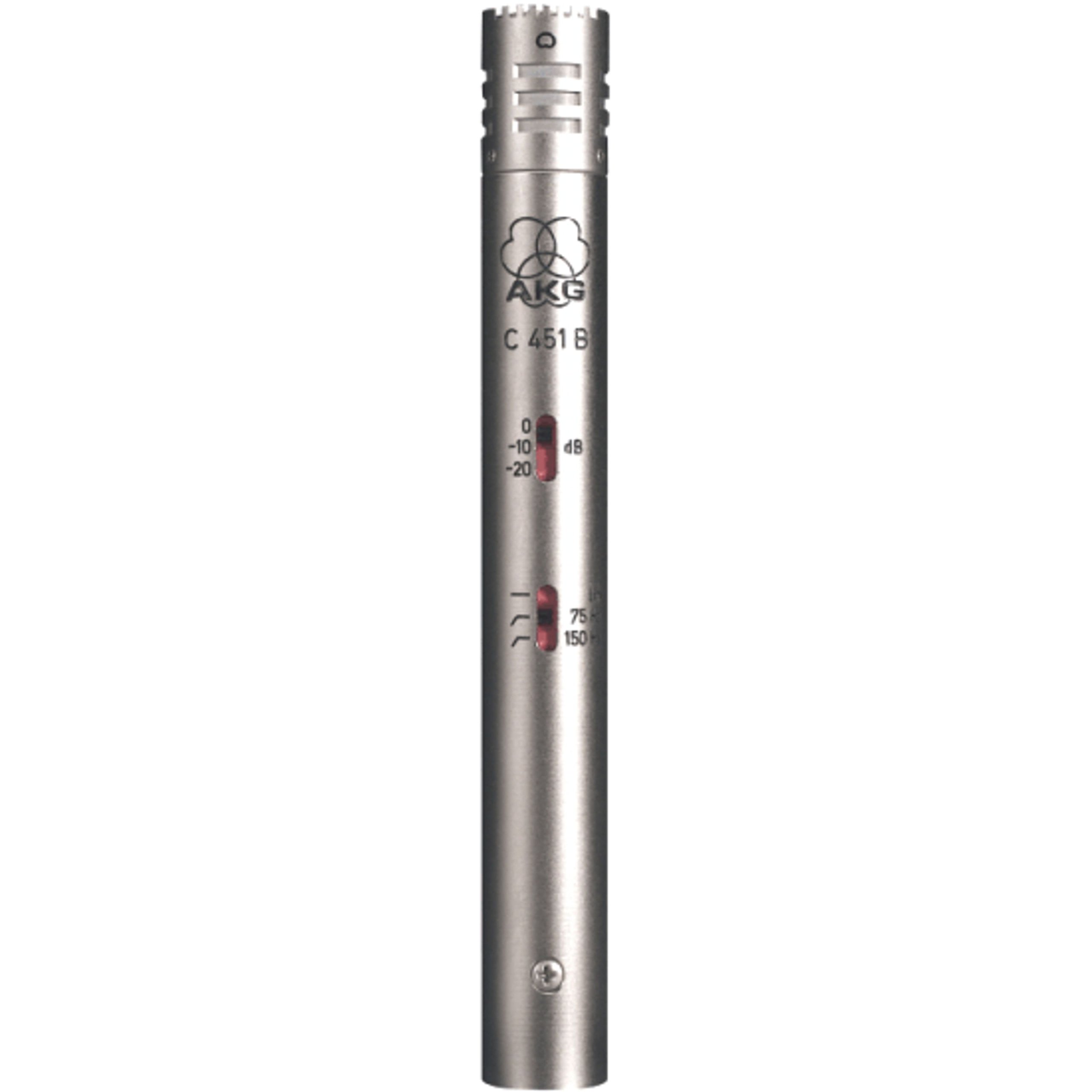
Image: The AKG C 451 B small-diaphragm condenser microphone, shown with its nickel finish and integrated stand adapter.
Główne cechy
- Acoustical Performance: Delivers stunning sound quality with maximum accuracy, replicating the legendary C451 EB + CK1 capsule.
- Roadworthy Design: An established tour sound standard since the 1980s, ensuring excellent sound quality even under harsh on-stagi warunki.
- High SPL Capability: Impressive sound pressure level capability of 155dB SPL allows close-miking of high-energy sound sources without distortion.
- Effective High-Pass Filter: Features a highly effective high-pass filter with 12dB/octave to prevent low-end distortion caused by rumble or wind noise.
- Low Distortion Preamp: Transformerless preamp and surface mount technology provide extremely low distortion, high reliability, and reduced weight.
Organizować coś
- Rozpakowywanie: Carefully remove the C 451 B microphone and any included accessories from its packaging. The package typically includes the microphone itself.
- Montowanie: Attach the microphone to a suitable microphone stand using the provided stand adapter. Ensure it is securely fastened.
- Połączenie: Connect the microphone to your audio interface, mixer, or preamplifier using a balanced XLR cable. The C 451 B requires 48V phantom power to operate. Verify that your connected device can supply this power and activate it.
- Pozycjonowanie: Position the microphone according to your recording or live sound needs. For instruments, experiment with distance and angle to achieve the desired sound.

Obraz: Zbliżenie view of the AKG C 451 B microphone, highlighting the XLR connector at the base and the switches for pad and high-pass filter.
Operating the C 451 B
The AKG C 451 B features switches on its body to adjust its response for various recording situations.
- Filtr górnoprzepustowy: The microphone includes a switchable high-pass filter (bass cut) with a slope of 12dB/octave. This filter helps to reduce unwanted low-frequency noise such as rumble, stage vibrations, or wind noise.
- Flat (0): No high-pass filtering applied.
- 75Hz: Engages a high-pass filter at 75 Hz.
- 150Hz: Engages a high-pass filter at 150 Hz.
- Pre-attenuation Pad: The C 451 B is equipped with a switchable pre-attenuation pad to handle very loud sound sources without overloading the microphone's electronics or the input of your preampliyfikator.
- 0dB: No attenuation applied.
- -10dB: Reduces the microphone's output by 10 dB.
- -20dB: Reduces the microphone's output by 20 dB.
Always ensure phantom power is supplied to the microphone for proper operation.
Konserwacja
- Czyszczenie: Do czyszczenia obudowy mikrofonu używaj miękkiej, suchej ściereczki. Unikaj stosowania płynnych środków czyszczących i rozpuszczalników, ponieważ mogą one uszkodzić wykończenie lub elementy wewnętrzne.
- Składowanie: When not in use, store the microphone in its protective case or a clean, dry environment to prevent dust accumulation and physical damage.
- Obsługiwanie: Handle the microphone with care. Avoid dropping it or subjecting it to strong impacts, which can affect its delicate internal capsule.
- Warunki środowiskowe: Protect the microphone from extreme temperatures, high humidity, and direct moisture.
Rozwiązywanie problemów
| Problem | Możliwa przyczyna | Rozwiązanie |
|---|---|---|
| Brak dźwięku | No phantom power; faulty cable; incorrect input selection on mixer/interface. | Ensure 48V phantom power is enabled. Check XLR cable for damage. Verify correct input channel is selected and gain is adjusted. |
| Zniekształcony dźwięk | Input overload (too loud source); pre-attenuation pad not engaged; excessive gain. | Engage the -10 dB or -20 dB pre-attenuation pad. Reduce the gain on your preamplifier or mixer. Move the microphone further from the sound source. |
| Excessive low-frequency noise (rumble) | Stage vibrations; wind noise; proximity effect. | Engage the high-pass filter (75 Hz or 150 Hz). Use a shock mount to isolate vibrations. Use a windscreen for outdoor or windy conditions. |
| Słaby lub niespójny sygnał | Faulty cable; insufficient phantom power; damaged microphone. | Try a different XLR cable. Confirm stable 48V phantom power supply. If issues persist, contact AKG support. |
Specyfikacje
| Funkcja | Szczegół |
|---|---|
| Współczynnik kształtu mikrofonu | Mała membrana |
| Wzór biegunowy | Jednokierunkowy |
| Technologia łączności | Przewodowy |
| Typ złącza | Zbalansowany XLR |
| Źródło zasilania | Przewodowy zasilacz elektryczny (zasilanie fantomowe 48 V) |
| Czułość audio | 155 Decibels (Max SPL) |
| Stosunek sygnału do szumu | 76dB |
| Odpowiedź częstotliwościowa | 20 Hz - 20 kHz |
| Waga przedmiotu | 1.19 funta (ok. 0.54 kg) |
| Wymiary produktu (dł. x szer. x wys.) | 11.7 x 5.9 x 3.5 cala (ok. 29.7 x 15 x 8.9 cm) |
| Tworzywo | Stal nierdzewna |
| Kolor | Nikiel |
| Zawarte komponenty | Mikrofon |
Gwarancja i wsparcie
Aby uzyskać informacje dotyczące gwarancji i pomocy technicznej, zapoznaj się z oficjalną stroną AKG webOdwiedź witrynę lub skontaktuj się z autoryzowanym dealerem AKG. Zachowaj dowód zakupu na wypadek roszczeń gwarancyjnych.
Zasoby internetowe: Odwiedź Sklep AKG na Amazon Aby uzyskać dodatkowe informacje o produkcie i akcesoriach.